
Hawaii HDOT MVSO Permit Practice Test 27
- Questions30
- Correct to pass24
- Passing score80%
- Minimum age15 years 6 months
-
1. The street you are turning right onto has a bike lane along its right edge. Where should your vehicle end up?
Show answer
Answer B: In the first traffic lane to the left of the bike lane
A bike lane is not a travel lane for motor vehicles, so the nearest lane you may finish a right turn in is the first general traffic lane beside it.
-
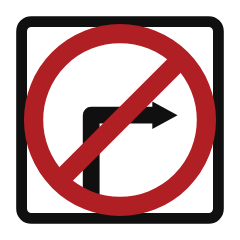
2. A driver's destination lies along the street to the right, and this sign stands at that corner. How should the driver reach it?
Show answer
Answer D: By going on and using a later intersection where turning is allowed
When a movement is barred at one corner the driver has to reroute, normally by continuing and coming back to the destination from a permitted approach.
-
3. On a two-lane road with a broken yellow center line, may you cross it to turn into a driveway on the left?
Show answer
Answer C: Yes, when it is safe and the oncoming lane is clear
A broken center line may be crossed for a pass or for a left turn into a road or a driveway, once the oncoming lane is clear.
-
4. A Kauai County applicant fails the written examination. How soon may it be attempted again?
Show answer
Answer D: After seven days
Kauai County imposes a minimum seven-day wait before a failed written examination may be retaken.
-
5. A sign at the approach to a bridge reads WEIGHT LIMIT 10 TONS. What does the figure set?
Show answer
Answer B: The heaviest vehicle the bridge may legally carry
A weight limit sign is a regulation based on what the structure can bear, and it applies to the loaded weight of the whole vehicle.
-
6. The car ahead of you slows down for no reason that you can see. Should you pull out and pass?
Show answer
Answer B: No, find out why it is slowing before you commit to the other lane
A driver usually slows for something, such as a turn, a hazard or a pedestrian, and that something is often exactly where your pass would take you.
-
7. What penalty does Hawaii attach to reckless driving of a vehicle?
Show answer
Answer C: A fine of up to one thousand dollars or up to thirty days in jail, or both
Operating a vehicle recklessly in disregard of the safety of persons or property carries a fine of not more than one thousand dollars or imprisonment of not more than thirty days, or both.
-
8. You realize you have just gone past your exit on a freeway. What should you do?
Show answer
Answer C: Carry on to the next exit and turn around there
A missed exit costs a few minutes, while backing up or cutting across the striped gore area puts you in the path of traffic that is not expecting it.
-
9. What should you do as you approach your exit from a roundabout?
Show answer
Answer A: Signal right and check the crosswalk for pedestrians before leaving
A right signal tells following drivers and waiting drivers that you are leaving, and pedestrians cross at the exit leg, so the crosswalk must be checked.
-
10. The brake pedal goes to the floor and the vehicle does not slow. What should you try first?
Show answer
Answer C: Pump the pedal quickly to try to build pressure
Most vehicles have a split braking system, so rapid pumping can often build enough pressure to slow you. If it does not, use the parking brake gradually.
-
11. You are waiting to turn left and an oncoming vehicle stopped in the near lane to turn left blocks your view of the far lane. What should you do?
Show answer
Answer A: Wait where you are until you can see that the far lane is completely clear
The lane you cannot see is where the crash comes from, so you hold your position until the view opens up.
-
12. While you are still on an entrance ramp, where should your attention be?
Show answer
Answer D: Along the ramp ahead and back at the highway traffic in the mirrors and over your shoulder
A merge needs both halves of the picture at once: the ramp curving ahead of you and the traffic you are about to join behind and to your left.
-
13. You are first in the queue at a red light with a marked crosswalk. Where should your vehicle stop?
Show answer
Answer A: Behind the stop line, so that the crosswalk stays clear
Stopping short of the line keeps the crosswalk usable for people on foot and keeps your vehicle out of the path of turning traffic.
-
14. A square sign with a red field, a wide white horizontal bar and the words DO NOT ENTER tells a driver that
Show answer
Answer B: the roadway ahead must not be entered from that point
The do not enter sign is posted at the end of a one-way roadway or ramp to keep traffic from driving into it against the flow.
-
15. What should you expect while driving through a parking lot?
Show answer
Answer D: Pedestrians and vehicles moving from any direction, so drive slowly
Parking lots mix walking people, reversing vehicles and poor sight lines, so low speed and constant scanning are the only reliable protection.
-
16. On a highway with mileage-based exit numbering, you have just passed exit 42 and are looking for exit 55. About how far is it?
Show answer
Answer B: Thirteen miles
With mileage-based numbering each exit takes the number of the nearest milepost, so subtracting one exit number from another gives the distance in miles.
-
17. You are turning left at an intersection just beyond the crest of a hill. What is the added risk?
Show answer
Answer B: Oncoming vehicles appear with very little warning and close quickly
A crest hides approaching traffic until it is close, so the gap you thought was empty can fill in the time the turn takes.
-
18. You have just returned to your own lane after passing. Why should you not slow down straight away?
Show answer
Answer A: The vehicle you passed is close behind and needs room to stop
Returning and then braking leaves the driver you just overtook with almost no following distance, which is how a pass turns into a rear-end collision.
-
19. What is the correct order of a pass on a two-lane road?
Show answer
Answer A: Check ahead and behind, signal left, move out, accelerate past, signal right and return
A pass begins with the decision that the road is clear and ends with a signaled return, and each step warns other drivers before the vehicle moves.
-
20. Your light turns green and a driver on the cross street enters against a red. What should you do?
Show answer
Answer D: Hold back and let that vehicle go through
Giving up a right of way you are entitled to is the only way to avoid a crash with a driver who has already failed to yield.
-
21. Why should you not rest your foot on the brake pedal as you drive?
Show answer
Answer D: The brake lights stay on and the drivers behind cannot read you
Resting on the pedal keeps the brake lights lit and wears the brakes, so following drivers stop believing your brake lights.
-
22. Visibility drops suddenly and you decide to leave the highway. What is the safest way to do it?
Show answer
Answer A: Take the next exit or a wide pull off, well clear of the traffic lanes
Get right off the traveled way, and off the shoulder too if you can, because vehicles in poor visibility often drift onto the shoulder.
-
23. You notice a bulge on the sidewall of one of your tires. What should you do?
Show answer
Answer D: Have the tire replaced before driving far, because it could blow out
A sidewall bulge means the internal cords have broken and only the rubber is holding the air. The tire can fail suddenly at any speed.
-
24. A yellow diamond shows a car with wavy lines behind its rear tires. What is the warning?
Show answer
Answer D: The surface loses grip badly when it is wet
The slippery when wet sign marks a stretch where traction falls off sharply in rain, so speed and braking must be reduced well in advance.
-
25. A vehicle ahead of you displays a reflective orange triangle on its rear. What does that emblem tell you?
Show answer
Answer B: The vehicle is built to travel at 25 mph or less
The orange triangle is the slow moving vehicle emblem used on farm and construction equipment designed for 25 mph or less, warning you that you are closing on it much faster than it appears.
-
26. How does a NO OUTLET sign differ from a DEAD END sign?
Show answer
Answer B: It warns that a whole group of streets has no way out
No Outlet is posted where the road leads into a network of streets from which there is no through route, while Dead End refers to the single street itself.
-
27. You are passing a tractor-trailer on a wet freeway and its wheels throw heavy spray. What is the best technique?
Show answer
Answer B: Increase your wipers and pass steadily without hesitating
Spray blinds you for as long as you stay beside the truck, so prepare the wipers first and then spend as little time in the spray as possible.
-
28. In normal operation, which indication always comes between a green and a red on the same signal face?
Show answer
Answer C: A steady yellow
The yellow change interval must follow every green or green arrow, so a signal can never jump straight from green to red.
-
29. You must cross a stretch of water lying across the road that you know is shallow. What is the right technique?
Show answer
Answer A: Slow down before you reach it and cross steadily in a low gear
Slow before the water, then keep a steady low speed so you do not throw water over the engine or lose steering. Test the brakes gently once you are through.
-
30. You are the first driver on a road just after a storm. What should you plan for?
Show answer
Answer B: Branches, mud and other debris hidden around the next bend
Storm debris lands where nobody has cleared it yet, often just beyond a curve or a crest, so reduce speed and look much further ahead.