
Hawaii HDOT MVSO Permit Practice Test 35
- Questions30
- Correct to pass24
- Passing score80%
- Minimum age15 years 6 months
-
1. You are parked legally, but a police officer tells you to move the vehicle. What should you do?
Show answer
Answer B: Move it as directed, because an officer overrides the signs
Directions from a police officer or a firefighter take precedence over signs and markings, whether they are directing traffic or clearing a street.
-
2. A curb lane is marked BUS ONLY 7 AM TO 9 AM. What may the driver of a car do?
Show answer
Answer A: Use the lane outside those hours
A part-time bus lane is reserved only during the posted period, and outside it the lane serves general traffic like any other.
-
3. Who must supervise a Hawaii instruction permit holder driving a car, and where must that person sit?
Show answer
Answer A: A licensed driver at least 21 years old, seated in the right front seat
Hawaii requires a supervising driver at least 21 years old who is licensed for that type of vehicle, and in all vehicles except motorcycles that person must occupy the right front seat.
-
4. You are entering an angle parking space on your right. What should you do?
Show answer
Answer C: Stay a little left of the space, then turn in between the lines
Keeping a little left of the space gives the front wheels the room to turn in cleanly and leaves your car centered between the lines.
-
5. The gates at a railroad crossing begin to come down as you approach. What must you do?
Show answer
Answer A: Stop and wait until the gates are fully raised and the lights stop flashing
Once the gates start down you must stop clear of the tracks and wait until they are fully raised and the warning lights have stopped.
-
6. You are waiting to turn left and a motorcycle is approaching from the opposite direction. Why should you take extra care judging its speed and distance?
Show answer
Answer A: Its small size makes it look farther away and slower than it really is
A motorcycle's narrow profile fools the eye, so drivers often misjudge how soon it will arrive. Left turns across an oncoming motorcycle are a leading cause of rider deaths.
-
7. Which vehicle is NOT within Hawaii's definition of an emergency vehicle for the stopped vehicle rule?
Show answer
Answer D: A refuse collection truck operated by a county public works department
The statutory list runs from police and fire vehicles through ocean safety, freeway service patrol, harbors division and conservation enforcement vehicles to tow trucks, but does not include refuse collection trucks.
-
8. Which color scheme is standard for the drums and barricades that channel traffic through a work zone?
Show answer
Answer C: Alternating orange and white retroreflective stripes
Drums and barricades carry alternating orange and white retroreflective stripes, and the traffic cones used in the same zones are predominantly orange.
-
9. A driver slows to walking pace at this sign, never stops rolling and eases into the intersection. How is that treated?

Show answer
Answer B: It is a violation, because the vehicle never came to a complete halt
What is required is a full halt with the wheels no longer turning, so slowing down, however carefully, does not satisfy it.
-
10. A signal on an entrance ramp changes from red to green and lets one vehicle at a time onto the highway. What should you do?
Show answer
Answer A: Stop on the red and go on the green, one vehicle for each green
A ramp meter spaces vehicles out so they join the highway one at a time instead of arriving as a group, and it is a traffic signal like any other.
-
11. What is the recommended minimum distance between the driver's breastbone and the center of the steering wheel air bag cover?
Show answer
Answer C: About 10 inches
An air bag inflates extremely fast, and keeping that much space lets it deploy fully before it reaches the driver, which is why the seat should be moved back as far as still allows comfortable control of the pedals.
-
12. What is the right speed for a normal right turn at a city corner?
Show answer
Answer C: Slow enough to hold your lane and stop for a pedestrian
A city right turn is tight and crosses a crosswalk, so the correct speed is one that keeps you inside your lane and still allows a stop.
-
13. A police officer in the intersection raises a hand toward you although your signal is green. What should you do?
Show answer
Answer B: Stop and wait for the officer to wave you on
An officer directing traffic overrides signals and signs, and drivers must follow the officer even when the light says otherwise.
-
14. Well before an intersection, an overhead sign shows a diagram of the lanes with an arrow above each one. What is its purpose?
Show answer
Answer C: To let drivers pick the correct lane in good time
Advance intersection lane control signs display the lane assignment far enough back that drivers can move over calmly instead of at the last moment.
-
15. How does a wet road change the distance you need to stop?
Show answer
Answer C: It lengthens it, so you need a much bigger gap ahead
Water between the tire and the road cuts grip, so braking distance grows and the gap that works on dry pavement is no longer enough.
-
16. Your vehicle has antilock brakes. What should you never do in an emergency stop?
Show answer
Answer A: Pump the pedal up and down
The system already releases and reapplies the brakes many times a second. Pumping the pedal interrupts it and makes the stop longer.
-
17. Which statement about standard drinks is correct?
Show answer
Answer C: A standard serving of beer, of table wine and of distilled spirits each contain about the same amount of pure alcohol
Roughly 12 ounces of regular beer, 5 ounces of table wine and 1.5 ounces of 80 proof spirits each contain about the same amount of pure alcohol, so the type of drink does not change the effect.
-
18. How long may a Hawaii license be revoked for refusing a requested alcohol test?
Show answer
Answer D: Two, four or eight years, depending on prior alcohol enforcement contacts
Hawaii revokes the license of a driver who refuses testing for two, four or eight years according to prior alcohol enforcement contacts, double the one, two or four year periods that apply to a driver who tests .08 or more, and the driver can still be charged with driving under the influence.
-
19. On an undivided two-lane road you meet a school bus coming toward you with its red lights flashing and its stop arm out. What must you do?
Show answer
Answer C: Stop and wait until the red lights stop flashing
On an undivided road drivers in both directions must stop for a school bus loading or unloading, because children may cross in front of it.
-
20. A driver moves into the space you were keeping ahead of you. What should you do?
Show answer
Answer D: Ease off and rebuild the gap in front of you
Losing a following gap is common in traffic; the answer is simply to drop back and recreate it rather than drive too close.
-
21. What is the maximum penalty in Hawaii for possessing an opened container of liquor while driving?
Show answer
Answer A: A fine of not more than two thousand dollars or thirty days in jail, or both
Consuming or possessing an opened container of intoxicating liquor while operating a motor vehicle or moped carries a fine of not more than two thousand dollars or imprisonment of not more than thirty days, or both.
-
22. Approaching the point this sign refers to, which hazard is most likely?
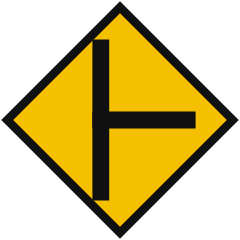
Show answer
Answer A: A vehicle pulling out from the entering road into the driver's path
The main risk is a driver on the entering road who misjudges the gap and pulls out, so covering the brake and being ready to slow is the sensible response.
-
23. What do yellow lines painted on a roadway separate?
Show answer
Answer D: Traffic moving in opposite directions
Yellow markings separate opposing streams of traffic, and they also mark the left edge of a divided highway or a one-way roadway.
-
24. The car ahead drifts across the lane line and back again several times. What should you do?
Show answer
Answer C: Assume that the driver is distracted or impaired, and keep well back
Drifting is a classic sign of a distracted, drowsy or impaired driver, and distance is your protection from all three.
-
25. In a vehicle with automatic transmission, which foot should operate the brake and accelerator?
Show answer
Answer D: The right foot for both pedals
Using only the right foot prevents pressing both pedals at once and keeps the response the same in every vehicle you drive. The left foot rests on the floor or the footrest.
-
26. What does Hawaii law mean by a highly intoxicated driver?
Show answer
Answer D: A driver whose measurable alcohol level is point one five or more
Hawaii defines a highly intoxicated driver as one with .15 or more grams of alcohol per hundred millilitres of blood, or the equivalent measured in breath.
-
27. Where is a three-point turn most clearly a bad idea?
Show answer
Answer A: On a busy street near a curve, where approaching drivers cannot see you
The maneuver leaves you blocking the road for several seconds, so it needs light traffic and a long clear view; a blind curve gives neither.
-
28. Why should heavy objects in the passenger compartment be secured?
Show answer
Answer A: Because loose objects fly forward in a crash and can injure the people
Anything loose keeps traveling at the speed of the vehicle when the vehicle stops, so it strikes the occupants with great force.
-
29. Which sign shape is reserved for one message only, the requirement to stop?
Show answer
Answer A: The octagon
The octagon is used for the stop sign and for no other message, so the outline alone identifies the requirement even when the legend is hard to read.
-
30. Why should you dim the instrument panel and keep interior lights off when driving at night?
Show answer
Answer C: Bright light inside the vehicle reduces your ability to see the dark road ahead
Your eyes adapt to the brightest light they see. A bright cabin keeps them from adjusting to the darkness outside and creates reflections on the windshield.