
Hawaii HDOT MVSO Motorcycle Practice Test 27
- Questions30
- Correct to pass24
- Passing score80%
- Minimum age15 years 6 months
-
1. What is wrong with riding in sneakers or sandals?
Show answer
Answer D: They come off, expose the foot and give no protection in a fall
Light footwear tears away or comes off in a crash and offers no abrasion or crush protection for the foot and ankle.
-
2. Why is parking against the flow of traffic dangerous even when nobody complains?
Show answer
Answer D: Because you had to cross traffic to get there and must cross again to leave
Parking on the wrong side means driving against traffic at both ends of the stop, and your reflectors and lights face the wrong way while you are there.
-
3. A steady red arrow is displayed for your left-turn lane at a two-way intersection. What must you do?
Show answer
Answer C: Stop and remain stopped until an indication permits the turn
A steady red arrow prohibits the movement it points to, so the driver stops and waits for a green arrow, a flashing yellow arrow or another indication that permits the turn.
-
4. What does this sign warn a driver about?
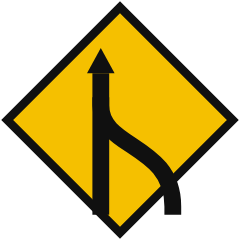
Show answer
Answer A: Traffic from another roadway will enter the same lane ahead
Two traffic streams come together into one lane beyond this point, so drivers on both roadways have to adjust speed and spacing to fit together.
-
5. Why do watering eyes matter so much to a rider?
Show answer
Answer D: Blurred vision delays the moment you see and react to a hazard
Wind makes unprotected eyes water, and even a brief loss of clear vision at road speed costs you the distance you need to react.
-
6. A dog runs out and chases your motorcycle. What is the recommended response?
Show answer
Answer D: Downshift and approach slowly, then accelerate away as you reach the animal
Approaching slowly keeps the dog aiming at where you are now, and accelerating as you reach it leaves the animal behind without a sudden swerve.
-
7. A SHOULDER DROP OFF sign warns that
Show answer
Answer B: there is a step down from the pavement to the shoulder
The sign is used where the edge of the pavement stands several inches above the shoulder, which can grab a wheel and pull the vehicle sideways.
-
8. How is the yield sign shaped and colored?
Show answer
Answer C: A downward-pointing triangle with a wide red border and a red legend on white
The yield sign is a downward-pointing equilateral triangle with a wide red border and the legend in red on a white background, an outline used for no other message.
-
9. Does using a hands free device remove the risk of distraction?
Show answer
Answer A: No, the conversation still takes attention away from driving
Hands free equipment removes the manual part of the distraction but not the mental part, and a driver deep in conversation can look straight at a hazard without registering it.
-
10. What should a rider check about the size of a motorcycle before riding it?
Show answer
Answer C: That both feet reach the ground and the controls are within reach
A motorcycle that fits lets the rider put both feet down at a stop and work every control without stretching, and a machine that is too tall or too heavy is hard to hold up in slow traffic.
-
11. Someone stops drinking heavily at two in the morning and drives to work at eight. What is true?
Show answer
Answer A: They may still be impaired and over the limit
The body removes alcohol at a slow, fixed rate, so a heavy night can leave a driver impaired well into the next morning no matter how they feel.
-
12. What extra restriction does Hawaii place on drivers under 18 regarding mobile electronic devices?
Show answer
Answer A: They may not use even a hands-free device, except to make a 911 emergency call
Hawaii bans holding a mobile electronic device for all drivers, and additionally bars drivers under 18 from using a hands-free device except for a 911 emergency communication.
-
13. As a general rule, how far should you travel along a center two-way left-turn lane before you turn?
Show answer
Answer C: Only a short distance, just enough to slow down and wait for a gap
The center lane is for making or preparing a left turn, so you enter it only shortly before the turn and never travel along it as a through lane; several states set a specific limit such as 200 or 300 feet.
-
14. You are stopped at the yield line of a roundabout when an emergency vehicle comes up behind you with lights and siren. What should you do?
Show answer
Answer A: Stay out of the roundabout and pull over to the right of your lane if there is room
Never enter a roundabout ahead of an emergency vehicle and never stop inside one; wait clear of the entry so the crew can get through.
-
15. A sign on a divided highway reads Keep Right Except to Pass. What does it require of you?
Show answer
Answer A: Use the left lane only to overtake, then return to a lane on the right
The left lane on such a highway is reserved for overtaking, so a driver who has finished a pass must move back to the right.
-
16. Where in the United States may a motorcycle ride between lanes of traffic?
Show answer
Answer C: Only where a state has specifically authorized it
Riding between lanes is prohibited in most states and permitted only where a state law expressly allows it, so a rider must know the rule for the state being ridden in.
-
17. You are stopped at a stop sign where your road ends at a two-way through street and you plan to turn left. What must you yield to?
Show answer
Answer B: Traffic from both directions and any pedestrians crossing
A left turn from the stem of a T crosses the near lane and joins the far one, so you give way to traffic in both directions and to pedestrians.
-
18. No plaque stating days or hours accompanies this sign at the intersection. When does the restriction apply?
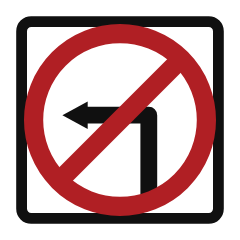
Show answer
Answer D: At all times, since nothing limits it to particular periods
A regulatory restriction runs continuously unless a supplemental plaque states the days or hours during which it applies.
-
19. In Hawaii, which blood alcohol range means a driver may be considered impaired rather than under the influence?
Show answer
Answer B: More than .05 percent but less than .08 percent
Hawaii treats a result above .05 percent and below .08 percent as impaired, and a result of .08 percent or more as under the influence of alcohol.
-
20. Why would this sign be installed on an approach?
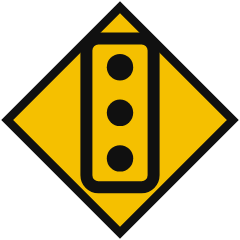
Show answer
Answer B: Because the signal cannot be seen from far enough back for a driver to react in time
Advance notice of a signal is used where a crest, a curve, trees or a building keep the signal heads out of view until a driver is already too close to stop comfortably.
-
21. Hawaii's basic speed rule names particular places where a safe and appropriate speed is required. Which of these does it list?
Show answer
Answer B: When approaching a hill crest or traveling on a narrow or winding roadway
The basic rule requires a safe and appropriate speed at intersections and railroad crossings, on curves and hill crests, on narrow or winding roads, and where special hazards exist.
-
22. What is the benefit of looking far down the road rather than just ahead of the hood?
Show answer
Answer A: You steer with smaller corrections and you see trouble in plenty of time
A distant view steadies your steering and gives you time to plan, because you meet hazards after you have already seen them.
-
23. You are turning left at an intersection just beyond the crest of a hill. What is the added risk?
Show answer
Answer B: Oncoming vehicles appear with very little warning and close quickly
A crest hides approaching traffic until it is close, so the gap you thought was empty can fill in the time the turn takes.
-
24. Which action makes a wobble worse instead of better?
Show answer
Answer A: Braking or accelerating to try to ride out of it
Braking or adding power during a wobble can amplify it. Close the throttle gradually, hold the bars firmly and let the speed fall until the machine settles.
-
25. Besides fitting the machine, what else must a passenger be capable of?
Show answer
Answer B: Following the rider's instructions throughout the ride
Instructions such as staying still, holding on and not getting off until told are what keep the pair balanced, and a passenger who cannot follow them is unsafe.
-
26. Your light is green but the traffic beyond the intersection is stopped and there is no room on the far side. What should you do?
Show answer
Answer A: Wait behind the line until you can clear the far side
Entering an intersection you cannot clear blocks the cross traffic when their signal turns green, so you wait behind the line.
-
27. How should you position your vehicle for a right turn from a two-way street?
Show answer
Answer B: As close as practical to the right curb or edge, then turn into the nearest right lane
Right turns are made from the lane nearest the right edge into the nearest available lane, which keeps the turn tight and prevents a wide sweep into other traffic.
-
28. Do hazard lights make it legal to leave your vehicle in a no parking zone?
Show answer
Answer A: No, they warn other drivers but do not permit the parking
Hazard lights are a warning device, not a permit; the parking restriction applies whether they are flashing or not.
-
29. A sign reads MINIMUM SPEED 40. What does it require of a driver?
Show answer
Answer C: Not to drive below that speed when conditions allow
A minimum speed limit keeps unnecessarily slow vehicles from obstructing traffic, but it never overrides the duty to slow down for weather or congestion.
-
30. You are on a country road with no sidewalk and two people are walking toward you on your side of the shoulder. What should you do?
Show answer
Answer C: Slow down and move over to give them room
Where there is no sidewalk, people are expected to walk on the shoulder facing traffic, and drivers must slow and give them space.