
Hawaii HDOT MVSO Motorcycle Practice Test 36
- Questions30
- Correct to pass24
- Passing score80%
- Minimum age15 years 6 months
-
1. At night you are judging your distance from the rider ahead by their tail light. What is the risk?
Show answer
Answer A: A single small light gives a poor sense of how far away it really is
Distance is very hard to judge from one small light in the dark, so riders should leave extra space rather than trust the impression the light gives.
-
2. Why are pedestrians and cyclists a special risk on unlit streets at night?
Show answer
Answer A: Dark clothing can make them invisible until they are very close
A person in dark clothing reflects almost no light and may not appear until they are inside your stopping distance, so cut your speed where people may be about.
-
3. You are following another vehicle down a long, steep grade. What should you do about the gap?
Show answer
Answer D: Make it longer, because both of you need more room to stop
Everything takes longer to stop on a downgrade, including the vehicle ahead, so the gap that works on the flat is no longer enough.
-
4. Is it acceptable to drive with your vehicle straddling the line between two lanes?
Show answer
Answer D: No, you must drive as nearly as practical entirely within a single lane
A vehicle astride the line takes up two lanes and leaves the drivers around it unable to predict where it will go.
-
5. An oncoming vehicle at night has its high beams on and you are being dazzled. Where should you look?
Show answer
Answer A: Toward the right edge of your lane
Looking toward the right edge line keeps you on course while sparing your eyes the worst of the glare. Slow down and do not retaliate with your own high beams.
-
6. Why must the handlebars be kept square during a hard straight line stop?
Show answer
Answer B: Because a front wheel turned under heavy braking can put the machine down
With the front tire loaded to its limit, any steering input asks it to do two jobs at once and the front end can wash out instantly.
-
7. Where must the engine cut-off switch be set before the starter button will crank the engine?
Show answer
Answer A: In the run position
The cut-off switch sits in the ignition circuit, so the engine will not start or run while it is set to off.
-
8. A square sign with a red field, a wide white horizontal bar and the words DO NOT ENTER tells a driver that
Show answer
Answer B: the roadway ahead must not be entered from that point
The do not enter sign is posted at the end of a one-way roadway or ramp to keep traffic from driving into it against the flow.
-
9. You are in the right-hand lane of a multilane street and that lane becomes a right-turn-only lane ahead, but you want to go straight. What should you do?
Show answer
Answer B: Change into a through lane before you reach the markings for the turn lane
A lane-use arrow is a regulatory marking, so a driver who wants to continue straight has to leave that lane before it becomes a mandatory turn lane.
-
10. Which driver is expressly exempt from Hawaii's ban on holding a device while driving?
Show answer
Answer B: A licensed amateur radio operator using a half-duplex two-way radio
The statute exempts drivers holding a valid amateur radio operator license from the Federal Communications Commission who are using a half-duplex two-way radio.
-
11. Which of these is checked in the Chassis step of T-CLOCS?
Show answer
Answer C: The frame, the suspension, the chain or belt and the fasteners
The chassis step covers the frame and its welds, the front and rear suspension, the final drive and the nuts and bolts holding everything together.
-
12. Your group arrives at a stop sign at a busy crossroad. How should each rider treat it?
Show answer
Answer C: Stop and pull out only when there is an adequate gap of your own
Following the machine ahead through a junction without looking is a common cause of group crashes, because the gap the leader used has already closed.
-
13. You are involved in a collision, even a minor one. What is your first legal duty?
Show answer
Answer A: Stop at or near the scene without blocking traffic more than necessary
Every driver involved in a crash must stop at the scene, and leaving before meeting that duty is a serious offense. Move the vehicles only as far as needed to clear the traffic lanes.
-
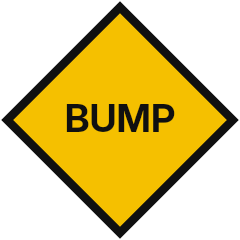
14. Why does this warning matter more on a motorcycle than in a car?
Show answer
Answer B: Because a sudden jolt can unsettle a two-wheeled machine and the rider can lose control
A jolt can push a motorcycle off line or lift a wheel, so a rider slows early, comes slightly off the seat and keeps a relaxed but firm hold on the handlebars.
-
15. Where are children in the greatest danger around a school bus?
Show answer
Answer B: In the roadway right around the bus, especially in front
The danger zone is the band of roadway around the bus where the driver's view is poorest, and children crossing in front of the bus are hardest to see.
-
16. You are turning right where a paved trail crosses the road just past the corner. What should you look for?
Show answer
Answer B: Cyclists and walkers arriving from either direction on the trail
A shared use path carries two-way traffic on foot and on bicycles, so scan both directions along the trail before crossing it.
-
17. A bicyclist in the bike lane ahead of you signals and starts to move left toward the turn lane. What should you do?
Show answer
Answer A: Slow down and let the rider move across
A bicyclist who needs to leave the bike lane to turn left is changing lanes like any driver, and following traffic should make room.
-
18. You are stopped at a T-intersection and a driver on the through road is signaling a right turn into your road. What is the safe assumption?
Show answer
Answer B: The driver may not actually turn, so wait until the vehicle slows and starts turning
A blinking signal may have been left on by mistake or may be for the next street, so wait until the vehicle actually slows and turns.
-
19. You expect to be out after dark on a sunny day's ride. What should you plan for eye protection?
Show answer
Answer B: Carry a clear shield to change to when the light drops
A tint that helps in daylight steals light you need at night, and riding with no eye protection is not the answer, so carry a clear shield and change it at dusk.
-
20. How should a rider adjust speed on an unlit road at night?
Show answer
Answer C: Slow enough to stop within the distance the headlight actually lights up
A rider can only react to what is visible, so night speed has to fit the distance the headlight reaches rather than the posted limit.
-
21. A white regulatory sign near a state line reads BUCKLE UP IT IS THE LAW. What is it doing?
Show answer
Answer A: Reminding occupants that belt use is required
The safety belt sign restates a law that already applies, and it is usually placed where drivers enter a state or a long rural stretch.
-
22. How do stimulant drugs such as amphetamines or cocaine typically affect driving?
Show answer
Answer D: They can make the driver overconfident and more willing to take risks
Stimulants create a false sense of alertness and encourage aggressive, risky driving. When they wear off, sudden fatigue can follow.
-
23. The vehicle ahead of you has pulled out to pass a truck. May you follow it out and pass as well?
Show answer
Answer B: No, wait until it is done and judge the road for yourself
You cannot see past the vehicle ahead of you, and if it has to abort the pass there is nowhere for either of you to go.
-
24. A traffic light ahead of the group turns yellow as the leader approaches it. What should the leader do?
Show answer
Answer C: Stop normally and let the group be split by the signal
Keeping the group together never outranks obeying the signal, and the riders left behind simply catch up at the next stop.
-
25. What is expressly NOT a consequence of breaching Hawaii's stopped emergency vehicle rule?
Show answer
Answer C: A requirement to furnish proof of financial responsibility
The statute states that a violation is not subject to the section requiring proof of financial responsibility to be furnished.
-
26. You are driving on a divided highway and see a solid yellow line along the left side of your lanes. What does it tell you?
Show answer
Answer D: It marks the left edge of the roadway for your direction
On a divided highway or a one-way roadway, the left edge of the traveled way is marked with a solid yellow line.
-
27. A fire truck with lights and siren has just passed you and is heading down the same road. How closely may you follow it?
Show answer
Answer B: Well back, because following a responding emergency vehicle closely is illegal
Following a responding emergency vehicle closely is prohibited; the exact minimum distance is set by each state, so stay far enough back to keep the scene and other responders clear.
-
28. You are waiting to turn left across two oncoming lanes when a driver in the near lane stops and waves you through. What should you do?
Show answer
Answer D: Turn only after checking the far lane yourself
The waving driver cannot give away the right of way of the traffic in the second lane, which may not be stopping at all.
-
29. How should a passenger swing their leg when getting off the motorcycle?
Show answer
Answer D: High and clear of the exhaust and the rear of the machine
A leg dragged low across the back of the motorcycle can catch the seat or the luggage and will find the hot exhaust, so it is lifted well clear.
-
30. You are about to pass a slower vehicle on a two lane road. What should you do with the gears?
Show answer
Answer B: Downshift before you begin, so the engine can accelerate strongly
A lower gear puts the engine in the part of its range where it accelerates best, which shortens the time spent in the oncoming lane.