
Hawaii HDOT MVSO Permit Practice Test 44
- Questions30
- Correct to pass24
- Passing score80%
- Minimum age15 years 6 months
-
1. You turn the wheel but the front of the vehicle keeps sliding straight ahead on a slippery road. What should you do?
Show answer
Answer C: Ease off the accelerator and reduce the steering angle until the front tires grip again
A front-wheel skid means the tires are asking for more grip than the surface can give. Less speed and less steering angle let them regain traction.
-
2. You park in your own driveway and the rear of the vehicle sticks out over the sidewalk. What is wrong with that?
Show answer
Answer C: It blocks the sidewalk and forces people into the street
A vehicle overhanging the sidewalk pushes pedestrians, wheelchair users and strollers into the roadway, and blocking a sidewalk is prohibited.
-
3. You are on an entrance ramp merging onto a freeway. Who has to give way?
Show answer
Answer B: You must yield and fit into a gap in the traffic already on the freeway
Traffic entering a highway must yield to traffic already on it. Use the acceleration lane to match speed and merge into a gap.
-
4. Another driver has pulled out to pass you. What should you do?
Show answer
Answer A: Stay in your lane, keep your speed steady or ease off, and let the pass finish
Accelerating while being passed forces the other driver to stay in the opposing lane longer, so the safe response is to hold or slightly reduce speed and stay right.
-
5. Your car is sinking after leaving the road into deep water and two children are in the back. In what order should you act?
Show answer
Answer D: Free yourself from the belt first, then release the children, the oldest one first
You cannot help anyone while you are still belted in, and the oldest child released first needs the least help getting out.
-
6. What does a sign showing a bicycle inside a red circle with a diagonal slash prohibit?
Show answer
Answer D: Riding a bicycle on that roadway
This is a selective exclusion sign, used where bicycles are banned from a road such as a freeway or a tunnel.
-
7. You are about to leave a roundabout when a pedestrian steps into the crosswalk on your exit. What should you do?
Show answer
Answer B: Yield to the pedestrian and wait for the crosswalk to clear
Roundabout crosswalks sit on the entries and exits, and drivers must yield to pedestrians using them.
-
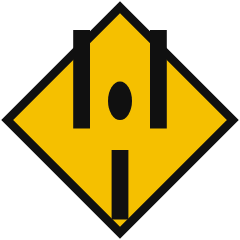
8. What change in the road does this sign announce?
Show answer
Answer B: The two directions of travel are about to be separated, and the driver must keep to the right of the separation
Ahead the roadway splits into separate one-way roadways on either side of a median, so the driver stays to the right of the divider and no longer meets oncoming vehicles.
-
9. You are the first to arrive at a crash on a rural road. What should you do first?
Show answer
Answer C: Park well clear of the scene, put on your hazard lights and call for help
Getting trained help on the way and keeping the scene visible does more good than anything an untrained bystander can do.
-
10. A steady green downward arrow is displayed above the lane you are in. What does it tell you?
Show answer
Answer A: You may drive in that lane
A green downward arrow means the lane beneath it is open for travel in your direction.
-
11. You have a steady green ball to turn left, and the oncoming traffic gets a green left arrow. What does that mean for you?
Show answer
Answer C: Oncoming vehicles will turn across your path, so you must wait
A green ball is permissive, so when the oncoming side receives a protected arrow those vehicles have priority and you must yield until they clear.
-
12. You are on a one-way street with two marked lanes. May you pass a slower vehicle on the right?
Show answer
Answer A: Yes, using the right lane, provided that the move is safe and signaled
On a roadway with two or more marked lanes in your direction, moving into the free lane and going by is a normal lane change rather than an unlawful pass.
-
13. What does a tire with worn tread do on a wet road?
Show answer
Answer B: It loses grip and it hydroplanes at a lower speed than a good tire
Tread grooves carry water away from the contact patch, and a worn tire cannot do that, so it floats on the water sooner.
-
14. Why does even a small reduction in speed matter so much where people are walking?
Show answer
Answer D: Because a pedestrian struck at a lower speed is far more likely to survive
The chance that a pedestrian survives falls steeply as impact speed rises, so a few miles per hour can decide the outcome.
-
15. You have stopped on the shoulder of a busy freeway with a flat tire that you cannot change safely. Where should you and your passengers wait?
Show answer
Answer A: Well away from the traffic side, behind a barrier or up the bank if there is one
People struck on the shoulder are a common cause of roadside deaths, so wait away from the traffic side and behind any barrier.
-
16. What is the basic rule for entering a roundabout?
Show answer
Answer B: Traffic already circulating goes first, and you wait for a gap
Entering traffic yields to vehicles already going around the circle, which is what keeps a roundabout moving instead of locking up.
-
17. You reach an intersection showing a steady red light, and a stop line is painted across your lane. Where must you bring the vehicle to a complete stop?
Show answer
Answer C: Before the stop line
A steady red requires a complete stop before the marked stop line. Where there is no stop line you stop before the crosswalk, and where there is neither, before entering the intersection.
-
18. You arrive at an intersection where the traffic signal is completely dark because of a power failure. How should you proceed?
Show answer
Answer C: Treat the intersection as an all-way stop
When a signal shows no indication at all, drivers on every approach must stop and then take turns, exactly as at an all-way stop.
-
19. What do white lane lines painted between travel lanes indicate?
Show answer
Answer A: Traffic in the adjacent lane moves in the same direction as you
White markings separate lanes carrying traffic in the same direction and mark the right edge of the roadway.
-
20. Who must be restrained by a seat belt in a Hawaii motor vehicle on a public highway?
Show answer
Answer D: The driver and all passengers in the front or back seat
Hawaii requires the driver and every passenger in the front or back seat to be restrained, with children under ten restrained under the child passenger restraint law instead.
-
21. A deer has just crossed in front of you on a stretch signed for animal crossings. What is the best assumption?
Show answer
Answer B: More animals are likely to follow the first one
Deer travel in groups, so one animal crossing usually means others are about to follow, and a driver should slow and keep scanning both shoulders.
-
22. You hear a bang and one of the front tires deflates while you are on the highway. What happens to the vehicle?
Show answer
Answer D: It pulls strongly toward the side that failed
The collapsed tire drags heavily on that corner, so the vehicle veers toward it. Hold the wheel firmly, keep your line and let the speed fall before leaving the road.
-
23. During the reversing part of a three-point turn, where should you be looking?
Show answer
Answer C: Over your shoulder through the rear window, glancing both ways
You look through the rear window in the direction the car is moving, checking both ways for traffic and people, because mirrors and cameras leave blind areas.
-
24. A yellow diamond showing the silhouette of a deer warns that
Show answer
Answer D: large animals may cross the road in that area
The sign marks a stretch where animals are known to cross, so drivers should reduce speed and scan both roadsides, especially around dawn and dusk.
-
25. You are stopped in slow traffic and a motorcycle comes up between the lanes. What should you do?
Show answer
Answer D: Hold your position and avoid any sudden lane change
The danger to a rider between lanes comes from a vehicle moving sideways without warning, so staying predictable is what protects them.
-
26. Alcohol is classified as which kind of drug?
Show answer
Answer B: A depressant that slows the central nervous system
As a depressant, alcohol slows the brain and nervous system, which lengthens reaction time and dulls the coordination that driving depends on.
-
27. You are behind a snow plow working on a highway. What is the correct way to drive?
Show answer
Answer C: Stay well back and do not try to pass it
A plow throws snow, runs wider than its body and works on the poor surface ahead of it, so the cleared road behind it is the safest place to be.
-
28. A grade crossing is marked only with a crossbuck and has no lights or gates. What does the crossbuck require of you?
Show answer
Answer C: Yield to rail traffic and cross only when no train is approaching
The crossbuck requires road users to yield the right-of-way to rail traffic, so you must look and listen and be ready to stop.
-
29. A black on white regulatory sign at an intersection reads NO TURNS. What may a driver do there?
Show answer
Answer B: Only continue straight through the intersection
The NO TURNS sign bans turns in every direction at that intersection, so the only lawful movement from that approach is straight through.
-
30. Where is the safest place for children under 13 to ride?
Show answer
Answer C: In the back seat
The back seat keeps children away from the force of a deploying front air bag and is farther from the most common impact area, which is why it is recommended through at least age 12.