
Hawaii HDOT MVSO Permit Practice Test 45
- Questions30
- Correct to pass24
- Passing score80%
- Minimum age15 years 6 months
-
1. A Hawaii driver is convicted of having no insurance for the second time in four years. What minimum fine applies?
Show answer
Answer C: Two thousand dollars
A subsequent no insurance offense occurring within five years of a prior one carries a minimum fine of two thousand dollars.
-
2. Once you have parallel parked, how close to the curb should your wheels be?
Show answer
Answer C: Within the distance your state allows, commonly 12 to 18 inches
Parking close to and parallel with the curb keeps the vehicle out of the traffic lane without damaging the tires; each state sets the exact maximum, usually 12 inches and 18 inches in some states.
-
3. A vehicle in the lane beside you has stopped at a crosswalk. What should you do?
Show answer
Answer C: Stop as well, because that driver may be yielding to a pedestrian you cannot see
The stopped vehicle hides the crosswalk from you, and passing it is a leading cause of collisions with pedestrians who are already crossing.
-
4. You are turning left from a one-way street onto a two-way street. How should the turn be made?
Show answer
Answer B: Start in the far left lane and finish just to the right of the center line
Left turns begin from the lane nearest the left edge of the street you are leaving and must finish on the right-hand side of the center line of a two-way street.
-
5. At which location is this sign normally installed?

Show answer
Answer D: Facing traffic that could turn into a one-way roadway or ramp against the flow
It is posted where a driver could otherwise enter a ramp or a one-way roadway from the wrong end, so it faces exactly the traffic that has to be kept out.
-
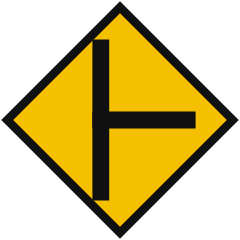
6. What condition does this sign warn a driver about?
Show answer
Answer B: Another road joins the road being traveled, from one side
It announces a side road entering the main roadway, so the driver should expect vehicles waiting to pull out and other vehicles slowing to turn in.
-
7. Under Hawaii's zero tolerance rule, drivers under 21 may not operate a vehicle with what blood alcohol content?
Show answer
Answer C: .02 or more
Hawaii prohibits drivers under 21 from operating a motor vehicle with a blood alcohol content of .02 or more.
-
8. Every signal head at an intersection is flashing red in all directions. How should you treat the intersection?
Show answer
Answer C: As an all-way stop, stopping and then going in turn
Red flashing in every direction means each approach must stop, so the intersection works exactly like an all-way stop.
-
9. Can a driver be charged with impaired driving after taking a legal over the counter medicine?
Show answer
Answer C: Yes, if the medicine impairs the ability to drive safely
Impaired driving laws cover any substance that affects driving, including cold remedies, allergy pills and sleep aids sold without a prescription.
-
10. The lane you are in has a right-turn-only arrow painted on the pavement. What must you do?
Show answer
Answer C: Turn right, because a lane-use arrow is a legal requirement
Lane-use arrows painted on the pavement are regulatory markings, so a driver in that lane must travel in the direction shown.
-
11. What is a good rule for any task you want to do inside the vehicle?
Show answer
Answer D: If it needs more than a moment, do it stopped
A glance of a second or two is manageable, but any task that runs longer belongs to a stopped vehicle, because the road does not pause while you do it.
-
12. You realize your tires are running on ice. Which set of inputs is safest?
Show answer
Answer C: Gentle steering, no sudden braking, and no sudden acceleration
Whatever grip is left is used up at once by any sudden input, so every movement of wheel, brake and accelerator must be slow and small.
-
13. A sign at the intersection prohibits U-turns, but the opening looks wide and clear. What may you do?
Show answer
Answer B: Obey the sign and turn around somewhere else
A prohibition applies whatever the traffic looks like at that moment, usually because of sight distance or conflicts you cannot see from the lane.
-
14. What fine does Hawaii set for exceeding the posted limit inside a school zone or a construction area?
Show answer
Answer A: Two hundred fifty dollars
Hawaii fixes a fine of two hundred fifty dollars for speeding in a school zone or a construction area, plus surcharges, and a school zone case adds a safe routes to school surcharge.
-
15. A highly intoxicated Hawaii driver with no prior contacts faces administrative revocation. What choice does the statute set out?
Show answer
Answer C: Eighteen months with an ignition interlock, or two years without one
For a highly intoxicated driver with a clean ten-year record, the revocation is eighteen months with mandatory ignition interlock installation, or two years without the device.
-
16. Why is a U-turn on a one-way street a problem?
Show answer
Answer A: You would end up facing the wrong way against all the traffic
Every lane of a one-way street runs the same way, so turning around leaves you driving head-on against all of the traffic.
-
17. What extra charge does Hawaii add when a driver exceeds the maximum speed limit by more than ten miles per hour?
Show answer
Answer D: A $10 surcharge deposited into the neurotrauma special fund
Hawaii imposes a $10 surcharge for the neurotrauma special fund, in addition to other penalties, when the maximum limit is exceeded by more than ten miles per hour.
-
18. What does the implied consent law mean for drivers?
Show answer
Answer D: By driving, you have agreed to a chemical test if lawfully arrested for impaired driving
Holding a license and driving on public roads is treated as consent to breath, blood or urine testing when an officer has grounds to arrest you. Refusing normally brings its own license penalties.
-
19. You are driving at night through heavy falling snow. Which headlight setting works better and why?
Show answer
Answer C: Low beams, because high beams bounce off the falling flakes back at you
Falling snow reflects light the way fog does, so high beams build a white wall of glare while low beams still give a usable view.
-
20. Which trailer lights must work before you drive away?
Show answer
Answer B: The tail lights, brake lights and turn signals
The trailer hides the vehicle lights from anyone behind, so its own tail, brake and turn signals have to work before you move.
-
21. You are approaching a narrow bridge where the road has one lane in each direction and no shoulder. What should you do about passing?
Show answer
Answer B: Do not pass on or near the bridge
A narrow bridge gives neither vehicle anywhere to go, so passing is prohibited there in the same way as on a hill or in a tunnel.
-
22. In a work zone a flagger signals you to stop, but the sign beside the road says the lane is open. What should you do?
Show answer
Answer C: Obey the flagger
A flagger controls the work zone in real time and the instruction outranks the signs and markings, which cannot reflect what is happening at that moment.
-
23. Cannabis is legal for adults in some states. What does that mean for driving?
Show answer
Answer C: Driving while impaired by it is still an offense
Legal possession has nothing to do with driving law, and every state treats driving while impaired by cannabis as an offense.
-
24. As a driver keeps drinking, in what order are driving abilities usually lost?
Show answer
Answer C: Judgment, then vision, reaction time and coordination
Alcohol reaches the parts of the brain that handle judgment first, and only later does it visibly affect sight, reactions and muscle control.
-
25. You are about to make a three-point turn on a narrow two-way street. What is the first step?
Show answer
Answer B: Pull close to the right edge, signal left and check traffic both ways
A three-point turn starts from a stop at the right edge with a left signal, and you only move once you have checked that both directions are clear.
-
26. May you stop in a marked bicycle lane to let a passenger out?
Show answer
Answer B: No, stopping there forces riders into the traffic lane
A vehicle stopped in a bike lane pushes riders out into moving traffic, which is exactly what the lane exists to prevent.
-
27. May you use a relative's accessible parking placard to park in a marked accessible space?
Show answer
Answer D: No, only when the placard holder is being transported in the vehicle
A placard belongs to the person, not to the car, so it is valid only when that person is being transported; using it otherwise takes a space from someone who needs it.
-
28. You are waiting to enter a two-lane roundabout and traffic is circulating in both lanes. What must you do?
Show answer
Answer A: Yield to traffic in both circulating lanes before you enter
Every entry to a roundabout is a yield point, and at a two-lane roundabout that means giving way to vehicles in either circulating lane.
-
29. You are stopped at a red light ready to turn right when a person pushing a stroller steps into the crosswalk. What should you do?
Show answer
Answer A: Stay stopped until they have crossed your path
A turn on red gives way to every pedestrian in the crosswalk, and someone pushing a stroller has even less room to react.
-
30. You are waiting inside the intersection to turn left when your light turns red. What should you do?
Show answer
Answer A: Complete the turn as soon as the way is clear
Once you have legally entered the intersection you should clear it as soon as the oncoming traffic has stopped, rather than sit in the path of cross traffic.