
Hawaii HDOT MVSO Permit Practice Test 46
- Questions30
- Correct to pass24
- Passing score80%
- Minimum age15 years 6 months
-
1. The center line beside your lane is a broken yellow line. What does it allow?
Show answer
Answer D: You may cross into the opposing lane to pass when it is safe and clear
A broken yellow center line marks a passing zone where traffic in that direction may cross into the opposing lane to pass when the way ahead is clear.
-
2. Rain is heavy enough that you have your windshield wipers running. What else should you switch on?
Show answer
Answer A: Your headlights, so you can see and others can see you
Rain heavy enough to need wipers also cuts how far away you can be seen, so the headlights belong on. Many states write this into law as a wipers on, lights on rule.
-
3. What does a sign reading Slower Traffic Keep Right require?
Show answer
Answer C: Traffic moving slower than the general flow must use the right-hand lane
The sign applies to any vehicle traveling below the speed of the traffic around it, which must keep right so faster vehicles can use the lanes to the left.
-
4. How should your speed behave while you move from one lane into the next?
Show answer
Answer C: Keep it steady or adjust it smoothly to match the traffic in the new lane
A lane change works best as a smooth movement at the speed of the lane you are joining, since sudden braking or acceleration surprises the drivers around you.
-
5. Which equipment is excluded from Hawaii's definition of a mobile electronic device?
Show answer
Answer B: Gear built into the vehicle for navigation or rear seat video entertainment
The definition excludes audio equipment and equipment installed in the vehicle for navigation, for emergency assistance to the operator, or for rear seat video entertainment.
-
6. A yellow lamp flashes above a warning sign at a sharp curve. What does it ask of a driver?
Show answer
Answer D: Slow down and pass the point with extra care
A warning beacon draws attention to the sign it is mounted with, and the message of the sign is what the driver must act on.
-
7. Traffic is backed up beyond a railroad crossing. When may you start across the tracks?
Show answer
Answer B: Only when there is room for your whole vehicle on the far side
Never enter a crossing you cannot clear; a vehicle stopped on the tracks in a queue has nowhere to go if the signals start.
-
8. You have a green left-turn arrow but a pedestrian is still walking in the crosswalk you must cross. What should you do?
Show answer
Answer B: Wait until the crosswalk is clear before turning
A green arrow protects you from other vehicles, but it never removes the duty to yield to a person already in the crosswalk.
-
9. You approach an intersection where the signal is flashing yellow. What should you do?
Show answer
Answer D: Slow down and cross the intersection with caution
A flashing yellow signal warns you to slow down and cross with care; it does not require a stop, but it does not give you priority either.
-
10. You brake hard on a wet road and need to steer around a stalled car. How do antilock brakes help you do that?
Show answer
Answer B: They stop the wheels locking, so the tires can still turn the vehicle
Locked wheels slide and cannot change direction. By preventing lockup the system lets you brake at full force and steer at the same time.
-
11. Do hazard lights make it legal to leave your vehicle in a no parking zone?
Show answer
Answer A: No, they warn other drivers but do not permit the parking
Hazard lights are a warning device, not a permit; the parking restriction applies whether they are flashing or not.
-
12. You wait in the aisle with your signal on for a space that is about to be vacated. What is the risk?
Show answer
Answer D: You block the aisle and drivers behind may try to squeeze past
A stopped vehicle turns a two-way aisle into a bottleneck, and drivers who try to get around it pass close to pedestrians and reversing cars.
-
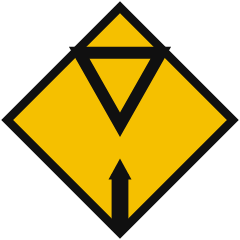
13. What will the driver have to do at the point this sign refers to?
Show answer
Answer C: Slow down and let conflicting traffic go first, stopping if that is what it takes
Further along, the driver has to let conflicting traffic and pedestrians go first, reducing speed and stopping whenever that is necessary to avoid interfering with them.
-
14. You are turning left at an intersection and an oncoming bicyclist is approaching in the bike lane. What must you do?
Show answer
Answer B: Yield and complete the turn only after the bicyclist has passed
A bicycle in the roadway has the same right of way as a vehicle, so a left-turning driver must yield to an oncoming rider just as to an oncoming car.
-
15. May you stop in the striped triangle that separates an exit ramp from the freeway lanes?
Show answer
Answer A: No, it is not a lane and stopping there is dangerous
The striped gore area is not a travel lane or a shoulder, and a vehicle stopped there sits directly in the path of drivers correcting a late exit.
-
16. At night you are waiting to turn left and can see only the headlights of an approaching vehicle. Why should you allow a bigger margin?
Show answer
Answer D: Because lights alone make speed and distance hard to judge
With no other visual cues, two points of light give you very little information about how fast the vehicle is closing, so leave extra margin.
-
17. Is it acceptable to leave your vehicle across the entrance of an alley for a short time?
Show answer
Answer A: No, the entrance must stay clear at all times
Blocking an alley entrance traps the vehicles inside and can keep emergency services out, so it is prohibited however brief the stop.
-
18. What does Hawaii charge a driver who fails to comply with the seat belt requirement?
Show answer
Answer A: A fine of forty-five dollars plus a ten dollar neurotrauma surcharge
Hawaii sets a forty-five dollar fine for each seat belt violation, together with a ten dollar surcharge paid into the neurotrauma special fund.
-
19. You hold steady pressure on the brake pedal for the whole of a long descent. What is likely to happen?
Show answer
Answer B: The brakes overheat and fade, so they slow you less and less
Continuous braking heats the brakes until they fade and lose effectiveness; use a lower gear and short, firm applications instead.
-
20. You drive onto a section where the top layer has been milled off and the surface is grooved. How will it feel?
Show answer
Answer C: The steering may wander, so hold the wheel firmly and slow down
Grooves cut into the pavement tug at the tires and make the steering feel restless. A firm grip and a lower speed keep the vehicle tracking straight.
-
21. You are turning left across tracks that run along the center of the street. What should you do before crossing them?
Show answer
Answer B: Look along the tracks in both directions and cross only when clear
Rail vehicles running in the street can arrive from either direction and cannot stop quickly, so look along the tracks before you turn across them.
-
22. A pedestrian steps off the curb in the middle of a block where there is no crosswalk at all. What is the legal position?
Show answer
Answer A: They must yield to you, but you must still avoid a crash
A pedestrian crossing away from a crosswalk yields to vehicles, yet every driver still has a duty to use care and avoid hitting a person.
-
23. When may a driver of a motor vehicle use a marked bicycle lane?
Show answer
Answer C: Only to cross it when turning or entering the road where the markings allow
A bike lane is a lane for cyclists. Motor vehicles may only cross it to enter or leave the road or to make a turn where the markings permit.
-
24. How much more energy must your brakes absorb if you double your speed?
Show answer
Answer D: About four times as much, since energy rises with the square of speed
Kinetic energy grows with the square of speed, so twice the speed means about four times the energy and a far longer braking distance.
-
25. A pedestrian waiting at a curb faces a steady upraised hand. What does that indication mean?
Show answer
Answer A: Do not start to cross in that direction
A steady upraised hand forbids entering the crosswalk, while a flashing hand only forbids starting a new crossing.
-
26. You are waiting in a center two-way left-turn lane. What should you expect from oncoming traffic?
Show answer
Answer A: Oncoming drivers may enter the same lane to prepare their own left turns
Both directions share a two-way left-turn lane, so an oncoming vehicle may be waiting in it and you must never treat it as yours alone.
-
27. Which of these is part of preparing a vehicle for winter driving?
Show answer
Answer A: Fitting good tires and using washer fluid that will not freeze
Winter readiness means tread, battery, wipers, antifreeze and washer fluid rated for the cold, plus a reasonable amount of fuel in the tank.
-
28. You leave your car so that its rear overhangs a marked crosswalk. What is wrong with that?
Show answer
Answer B: Pedestrians must step around it into the traffic lane
A crosswalk has to stay completely clear; anything sticking into it pushes people on foot out into the path of moving vehicles.
-
29. What must a driver be ready to do along the stretch of road where this sign is posted?

Show answer
Answer D: Slow down and stop for a child who steps into the roadway
Children misjudge speed and distance and act without warning, so the driver reduces speed, covers the brake and scans the sidewalks and parked vehicles.
-
30. At a freeway exit, the paved triangle between the ramp and the through lanes is filled with diagonal white lines. What do they mean?
Show answer
Answer A: Stay out of that area, because it is not meant to be driven on
Chevron and diagonal markings fill paved areas that traffic is not intended to use, so drivers should keep out of them.