
Hawaii HDOT MVSO Motorcycle Practice Test 45
- Questions30
- Correct to pass24
- Passing score80%
- Minimum age15 years 6 months
-
1. A notification appears on your smart watch while you are driving. What should you do?
Show answer
Answer B: Treat it as you would a phone and leave it
A watch screen demands the same eyes and the same attention as a phone, and a wrist is no safer a place to read a message than a dashboard.
-
2. Which part of the space around your vehicle can you control best?
Show answer
Answer A: The space ahead of you
You choose your own following distance, so the gap in front is the space you truly control and the one that gives you time to react.
-
3. How is a wheel bearing checked during an inspection?
Show answer
Answer A: Raise the wheel clear of the ground and rock it side to side to feel for play
A worn bearing shows itself as side to side play in a raised wheel, and it may also feel rough or notchy when the wheel is spun.
-
4. How is a breach of Hawaii's mobile electronic device law classified?
Show answer
Answer C: As a traffic infraction
Hawaii treats a violation of the mobile electronic device law as a traffic infraction as defined in the traffic infractions chapter.
-
5. You are traveling a long distance on a highway with three lanes in your direction, at about the speed of the surrounding traffic. Which lane is generally the best choice?
Show answer
Answer C: The center lane, which keeps you clear of merging traffic and of overtaking traffic
On a three-lane roadway the center lane avoids both the ramp traffic on the right and the overtaking traffic on the left, so it usually has the steadiest flow.
-
6. How long is the nonrefundable insurance policy that a Hawaii court may require instead of suspending the license?
Show answer
Answer A: Six months
As an alternative to suspension, the court may require the driver or registered owner to keep a nonrefundable motor vehicle insurance policy in force for six months.
-
7. A signal stands part way up a freeway entrance ramp and turns green briefly again and again. How many vehicles does such a signal normally release on each green?
Show answer
Answer A: One for each lane of the ramp
A ramp control signal releases a single vehicle per lane on each green so that vehicles reach the merge one at a time instead of in a bunch.
-
8. A yield sign is posted where an entrance ramp meets the highway. What must you do?
Show answer
Answer C: Give way to the traffic already on the highway and merge into a gap
The yield sign confirms that the merging driver is the one who must fit into the traffic stream rather than the other way round.
-
9. A Hawaii driver breaches the stopped emergency vehicle rule and someone is injured as a result. What follows?
Show answer
Answer D: The driver is charged instead under the negligent injury or homicide sections
Where a death or injury is attributable to the driver, the case is charged under the negligent homicide or negligent injury sections of the penal code rather than as a traffic violation.
-
10. Why is smooth, early braking better than hard, late braking?
Show answer
Answer D: It keeps you in control and gives the driver behind more warning
Braking early and gently keeps the tires well within their grip and gives following drivers time to react to your brake lights.
-
11. How do the traffic laws apply to riders traveling in a group?
Show answer
Answer D: Every rider is responsible for obeying the law on their own machine
Riding in company changes nothing legally, and each rider answers individually for speed, signals and every other rule of the road.
-
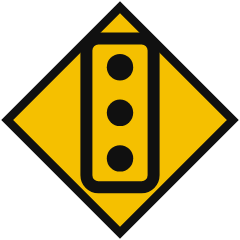
12. What does this sign require of the driver?
Show answer
Answer D: Reducing speed and being ready to stop at the intersection ahead
The advance notice asks the driver to slow and be ready to stop, while whether a stop is actually needed depends on the indication displayed on arrival.
-
13. With the chin strap fastened, how can you check that a helmet is the right size?
Show answer
Answer A: Try to roll it forward off your head, since a good fit will not come off
The roll off test shows whether the helmet will stay on in a crash. If it can be rolled off the front of your head with the strap done up, it is too big.
-
14. You find that the road surface has turned to sheet ice. What speed is appropriate?
Show answer
Answer A: A crawl, slow enough that you could stop without braking hard
Ice can cut grip to a fraction of normal, so stopping takes many times the usual distance and only a crawl leaves any margin.
-
15. A signal beside a fire station stays dark until apparatus is about to leave, when it shows yellow and then red. What must a driver do?
Show answer
Answer B: Stop on the red and wait until the signal goes dark again
An emergency vehicle signal is a real traffic signal, so its red indication must be obeyed while the apparatus pulls out into the street.
-
16. Why should a rider avoid riding through a puddle that spans the lane?
Show answer
Answer D: It can hide a deep hole or broken pavement under the surface
Standing water conceals what is underneath it, so treat a puddle as an unknown surface and go around it whenever you safely can.
-
17. You arrive at an intersection where the traffic signals are completely dark after a power failure. What should you do?
Show answer
Answer A: Treat the intersection as an all-way stop and take turns
When a signal is dark or out of order, drivers on every approach must stop and proceed in turn, exactly as at a four-way stop.
-
18. What should the clutch be doing during a quick stop?
Show answer
Answer C: Pulled in as the motorcycle slows, so the engine does not stall
Disengaging the clutch as the machine slows keeps the engine running, so the rider can pull away again immediately if that becomes necessary.
-
19. Visibility drops suddenly and you decide to leave the highway. What is the safest way to do it?
Show answer
Answer A: Take the next exit or a wide pull off, well clear of the traffic lanes
Get right off the traveled way, and off the shoulder too if you can, because vehicles in poor visibility often drift onto the shoulder.
-
20. Traffic is heavy and you find yourself riding level with a car in the next lane. What is the problem with staying there?
Show answer
Answer B: You sit in the driver's blind spot, so a lane change could hit you
Motorcycles disappear easily in a blind spot, so adjust your speed to ride ahead of or behind the other vehicle instead of beside it.
-
21. Besides the traffic behind you, what else must you check before moving into the next lane?
Show answer
Answer D: That there is room ahead in the new lane for your normal following distance
Moving into a gap that is too short leaves you tailgating the vehicle ahead with a vehicle close behind you.
-
22. What is the purpose of the padding built into the shoulders, elbows and knees of riding gear?
Show answer
Answer C: It absorbs impact energy at the joints most likely to strike first
Armor at the joints spreads and absorbs the force of an impact in the places that usually hit the ground first in a fall.
-
23. Why is it harder for a rider to judge distance and closing speed after dark?
Show answer
Answer D: Only lights are visible, so closing speeds are hard to read
At night you see lights rather than whole vehicles and the scene around them, which strips away the cues that tell you how far away something is and how fast it is closing.
-
24. A lane control sign over one lane shows both a straight arrow and a left arrow. What does it tell drivers in that lane?
Show answer
Answer A: Either movement may be made from that lane
An optional movement lane control sign lists every movement permitted from the lane, so a driver may choose any arrow shown.
-
25. May you stop in the striped triangle that separates an exit ramp from the freeway lanes?
Show answer
Answer A: No, it is not a lane and stopping there is dangerous
The striped gore area is not a travel lane or a shoulder, and a vehicle stopped there sits directly in the path of drivers correcting a late exit.
-
26. Why can a mild afternoon still chill a rider dangerously on the highway?
Show answer
Answer B: Riding speed creates a wind chill well below the air temperature
Air moving over the body at highway speed strips heat far faster than still air, so a comfortable temperature at a standstill can cause serious chilling in an hour of riding.
-
27. Someone appears seriously injured after a crash. What should you generally do?
Show answer
Answer C: Call for emergency help and avoid moving the person unless there is an immediate danger such as fire
Moving an injured person can worsen spinal or internal injuries, so summon trained help and leave the person in place unless staying there is more dangerous than moving.
-
28. What does a tire with worn tread do on a wet road?
Show answer
Answer B: It loses grip and it hydroplanes at a lower speed than a good tire
Tread grooves carry water away from the contact patch, and a worn tire cannot do that, so it floats on the water sooner.
-
29. Why should riding clothing have no loose flapping parts?
Show answer
Answer B: Loose cloth can catch on the machine, and flapping tires the rider
Loose fabric can snag on the controls, the chain or a wheel, and the constant flapping and noise wear the rider out over a long ride.
-
30. How should a rider use the head and eyes in a turn?
Show answer
Answer A: Turn only the head to look through the turn, keeping the eyes level with the horizon
Turning just the head keeps the upper body from upsetting the motorcycle, and level eyes help the rider judge lean angle and direction.