
Hawaii HDOT MVSO Motorcycle Practice Test 46
- Questions30
- Correct to pass24
- Passing score80%
- Minimum age15 years 6 months
-
1. What does Hawaii law mean by a highly intoxicated driver?
Show answer
Answer D: A driver whose measurable alcohol level is point one five or more
Hawaii defines a highly intoxicated driver as one with .15 or more grams of alcohol per hundred millilitres of blood, or the equivalent measured in breath.
-
2. A large panel mounted on a trailer at the roadside displays a flashing arrow pointing left. What does it tell you?
Show answer
Answer B: Move into the lane to your left
An arrow panel directs traffic out of a closed lane, so the arrow shows the direction you must move rather than the shape of the road ahead.
-
3. You approach a one-lane bridge and there is a yield sign facing your side of it. What does that mean?
Show answer
Answer B: Oncoming traffic crosses the bridge first and you wait at the approach
At a one-lane bridge the yield sign tells one direction to give way, so you wait clear of the bridge until oncoming traffic has crossed.
-
4. An overhead sign shows that the right lane is EXIT ONLY. What does that mean if you intend to stay on the highway?
Show answer
Answer B: You have to move out of that lane before the exit
An exit only lane leaves the highway completely, so a driver continuing on the highway has to change lanes before it does.
-
5. What is the main reason a rider should keep a generous following distance on a rough, broken road?
Show answer
Answer B: So the rider can see and plan for holes and broken pavement in time to react
The vehicle ahead hides the pavement, so extra space gives you time to spot a hole or a broken edge and to choose a path around it.
-
6. When should most of your braking for a turn be finished?
Show answer
Answer B: Before you begin to turn the wheel
Slow to the right speed before the turn begins; braking hard while turning uses up the grip the tires need for steering.
-
7. Your phone is in a mount on the dashboard rather than in your hand. What is true?
Show answer
Answer B: It still takes your eyes and mind off the road
A mount solves the hand problem but not the eye or the mind problem, and reading or tapping a mounted screen costs the same seconds of attention.
-
8. A helmet falls from the seat onto a hard floor but shows no cracks. What should the owner do?
Show answer
Answer C: Replace it or have it checked, because the liner can be crushed inside
The foam liner can be compressed with no outside sign, and crushed foam will not absorb a second impact, so a helmet that has taken a hard knock should be replaced.
-
9. On a highway with mileage-based exit numbering, you have just passed exit 42 and are looking for exit 55. About how far is it?
Show answer
Answer B: Thirteen miles
With mileage-based numbering each exit takes the number of the nearest milepost, so subtracting one exit number from another gives the distance in miles.
-
10. Why do many crashes happen on routes the driver knows very well?
Show answer
Answer D: Familiar roads let attention slip into routine
When a route is automatic the mind wanders and hazards get missed, which is why a well known road deserves the same attention as a strange one.
-
11. Your vehicle stalls on a railroad crossing and will not restart. What should you do first?
Show answer
Answer A: Get everyone out and away from the tracks immediately
Everyone must leave the vehicle and move well clear of the tracks at once, walking toward the train at an angle so that debris from an impact travels away from you.
-
12. Traffic is backed up on the far side of a railroad crossing. What should you do before driving onto the tracks?
Show answer
Answer D: Wait behind the tracks until there is room to clear them completely
Never enter a crossing until you are certain you can drive completely across without stopping, because a vehicle trapped on the tracks cannot get out of a train's way.
-
13. You are on an entrance ramp joining a busy freeway. What should you do with your speed in the acceleration lane?
Show answer
Answer D: Build it up to about the speed of the traffic you are joining
Merging works when your speed matches the traffic stream, because a large speed difference forces the drivers already on the freeway to brake or swerve.
-
14. You are driving on a road covered with a layer of wet fallen leaves. What should you expect?
Show answer
Answer B: As little grip as on ice, plus hidden markings and hidden holes
Wet leaves are as slippery as ice and they hide the lane lines and any potholes underneath, so slow well before curves and stops.
-
15. What should the operator do while a passenger climbs on board?
Show answer
Answer D: Sit on the machine with both feet planted and the front brake held on
The added weight arrives suddenly and off center, so the operator braces the motorcycle with both feet down and the front brake applied to keep it still.
-
16. Where is a road work ahead sign placed?
Show answer
Answer B: In advance of the work space or detour, so drivers are warned before reaching it
Advance warning signs are placed upstream of the work space or detour so that drivers have time to slow down and change lanes before reaching the activity.
-
17. Why do groups agree on a set of hand signals before setting off?
Show answer
Answer B: Because engine noise and helmets make speech useless between moving machines
Riders cannot talk to each other while moving, so agreed signals for hazards, stops, fuel and single file keep the whole group informed.
-
18. A tow truck with flashing amber lights is loading a car on the shoulder ahead. How should you treat it?
Show answer
Answer B: Give it the same room as an emergency vehicle
Tow operators, utility crews and highway workers face the same danger from passing traffic, so move over or slow down for their flashing amber lights too.
-
19. You have stopped after a crash. Why should the engines of the vehicles involved be switched off?
Show answer
Answer A: To reduce the risk of a fire starting around any fuel that has spilled
Crashes often break fuel lines, and a running engine is a source of ignition, so switching off lowers the risk of fire.
-
20. Driving at night you notice that the raised markers along the line beside you are throwing back red light. What does that tell you?
Show answer
Answer C: You are facing traffic and must get off that roadway
Red retroreflection is shown only toward traffic that should not be there, so a red return means the vehicle is heading the wrong way.
-
21. On a wet road, how should a driver adjust after passing this sign?
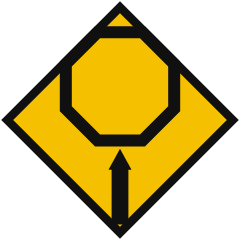
Show answer
Answer B: Start braking earlier, because a slippery surface lengthens the stopping distance
A wet surface lengthens stopping distance, so the extra warning distance should be spent braking gently and early instead of late and hard.
-
22. You are stopped in a line of traffic on a steep uphill grade. What should you do about the gap to the vehicle ahead?
Show answer
Answer B: Leave more room than usual, because vehicles can roll back as they pull away
A vehicle ahead can roll back a foot or more as its driver releases the brake, and a motorcycle stopped tight behind it has nowhere to go.
-
23. You make eye contact with a driver waiting to pull out of a side street. What should you assume?
Show answer
Answer D: The driver may still not have seen you, so stay ready to slow or stop
Drivers can look directly at you and still not register your vehicle, especially a small one. Eye contact helps, but never rely on it.
-
24. You know in advance that you will be drinking at an event. What is the most reliable plan?
Show answer
Answer A: Arrange a driver who will not drink, or another way home, before the event begins
A decision made before drinking is not affected by alcohol, while judging your own fitness afterward relies on the very ability alcohol impairs first.
-
25. You are driving through a residential area where parked cars hide the side streets. What is the safest approach?
Show answer
Answer C: Slow down and cover the brake as you pass each opening
Where parked vehicles hide side streets and driveways, lower speed and a covered brake buy the time you lose in sight distance.
-
26. A driver moves into the space you were keeping ahead of you. What should you do?
Show answer
Answer D: Ease off and rebuild the gap in front of you
Losing a following gap is common in traffic; the answer is simply to drop back and recreate it rather than drive too close.
-
27. What is the correct way to ride across a stretch of slippery pavement?
Show answer
Answer C: Reduce speed before you reach it, avoid sudden moves, and use both brakes gently if you must brake
The speed must come off before the slippery area, and once the tires are on it every input, braking included, has to be smooth and gentle.
-
28. You are on a city street with two lanes in your direction, cars parked along the curb and driveways every few yards. Which lane is usually safer?
Show answer
Answer B: The lane farther from the curb, away from opening doors and vehicles pulling out
Most of the hazards on such a street come from the curb side, so the inside lane gives you more space and more time to react.
-
29. What is true about the oily strip down the center of a traffic lane?
Show answer
Answer D: It usually gives enough traction, but heavy buildups where vehicles idle should be avoided
Passing tires keep the central strip largely clear, but the thick deposits that collect at busy intersections and toll booths really are slick.
-
30. Trees block the view along the tracks as a driver approaches this sign. What approach speed is correct?

Show answer
Answer B: Slow enough to stop before the nearest rail once a train comes into view
Where the view along the track is obstructed, the only safe speed is one that still leaves stopping distance after a train first becomes visible.