
Hawaii HDOT MVSO Permit Practice Test 10
Test 10 of 10. Pick an answer for each question to see if it is right and why; your score appears at the end. You need 24 correct answers to pass, the same ratio as the real Hawaii test.

- Questions30
- Correct to pass24
- Passing score80%
- Minimum age15 years 6 months
-
1. What two age rules apply to electric foot scooters in Hawaii?
Show answer
Answer D: No operation under fifteen, and a helmet required for anyone under sixteen
Hawaii bars anyone under fifteen from operating an electric foot scooter on public roads and requires a securely fastened helmet for any rider under sixteen.
-
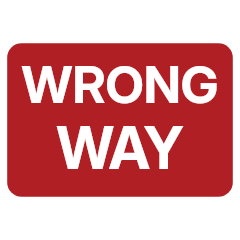
2. At a freeway exit ramp, this sign normally backs up which other regulatory sign posted nearer to the ramp terminal?
Show answer
Answer D: The sign that forbids entering that roadway at all
The two work as a pair at ramp terminals: one keeps drivers from turning in, and this one sits farther along to catch a driver who has already entered.
-
3. Under Hawaii's no-fault scheme, when may an injured person sue for bodily injury?
Show answer
Answer C: When medical bills exceed five thousand dollars, or there is permanent loss or death
A bodily injury claim may be brought only where medical bills exceed five thousand dollars, where a part or function of the body is permanently lost or serious disfigurement results, or where the injury causes death.
-
4. A highly intoxicated Hawaii driver with no prior contacts faces administrative revocation. What choice does the statute set out?
Show answer
Answer C: Eighteen months with an ignition interlock, or two years without one
For a highly intoxicated driver with a clean ten-year record, the revocation is eighteen months with mandatory ignition interlock installation, or two years without the device.
-
5. What fine does Hawaii impose for using a mobile electronic device while driving, and what changes in a school zone or construction area?
Show answer
Answer C: $300, rising to $400 in a school zone or construction area
Hawaii sets a $300 fine for the offense and raises it to $400 when it happens in a school zone or construction area as defined by state law.
-
6. What do white lane lines painted between travel lanes indicate?
Show answer
Answer A: Traffic in the adjacent lane moves in the same direction as you
White markings separate lanes carrying traffic in the same direction and mark the right edge of the roadway.
-
7. You must slow suddenly on a highway and a vehicle is following close behind you. What helps prevent a rear-end collision?
Show answer
Answer D: Tapping the brake pedal early so your brake lights flash a warning
Early brake light flashes give the driver behind more time to react, and slowing gradually instead of suddenly reduces the chance of being struck.
-
8. Which effect appears as a drinker's blood alcohol level climbs well past the first drinks?
Show answer
Answer D: Loss of muscle control and steady steering
Higher levels of alcohol reach the parts of the brain that control movement, which shows up as clumsy steering, late braking and poor lane control.
-
9. A driver extends the left arm out the window and bends it upward at the elbow. What does this signal mean?
Show answer
Answer B: A right turn
The left arm bent upward at the elbow is the standard hand signal for a right turn.
-
10. Traffic has built up behind you while you wait for a gap to turn left. How should that affect your decision?
Show answer
Answer C: It should not change it; wait for a gap that is genuinely safe
Pressure from behind does not make a small gap bigger, and rushing a left turn across traffic is a common cause of serious crashes.
-
11. What kind of vehicle may be driven on the roadway between the Waipio valley lookout and the valley floor?
Show answer
Answer D: A low-range four-wheel drive vehicle
Only a low-range four-wheel drive vehicle may be driven on the connecting roadway between the Waipio valley lookout and the valley floor, and an all-wheel drive vehicle does not qualify.
-
12. How close may a Hawaii driver follow an emergency vehicle that is traveling in response to an emergency?
Show answer
Answer C: No closer than five hundred feet
A driver not on official business may not follow an emergency vehicle responding to an emergency closer than five hundred feet.
-
13. A line beside your lane is painted about twice the normal width. What does the extra width convey?
Show answer
Answer B: Greater emphasis on the restriction it carries
Width is part of the marking code: a wide line carries more emphasis than a normal one, which is why it is used at gores and channelizing lines.
-
14. You have a steady green ball to turn left, and the oncoming traffic gets a green left arrow. What does that mean for you?
Show answer
Answer C: Oncoming vehicles will turn across your path, so you must wait
A green ball is permissive, so when the oncoming side receives a protected arrow those vehicles have priority and you must yield until they clear.
-
15. On the Daniel K. Inouye Highway, which stretch carries the lower statutory speed limit?
Show answer
Answer C: The section beginning at the Pohakuloa training area and ending east of Mauna Kea county park
The statute drops the limit to forty-five miles per hour, or another limit set under the general speed sections, from the Pohakuloa training area to half a mile east of the Mauna Kea county park entrance.
-
16. A Hawaii provisional licensee is lawfully driving home from work at 11:30 p.m. What passenger rule still applies?
Show answer
Answer D: No more than one person under eighteen may be carried without a parent along
Even when driving under the employment or school activity exception, the provisional licensee may not transport more than one person under eighteen between 11:00 p.m. and 5:00 a.m. without a licensed parent or guardian.
-
17. Why should you set the parking brake even when an automatic transmission is in Park?
Show answer
Answer B: Because it takes the strain off the transmission and holds the vehicle
The parking pawl is a small part carrying the whole vehicle; the parking brake shares that load and holds the vehicle if the pawl fails.
-
18. Which trucks and vans may be driven on a Hawaii category 3 license?
Show answer
Answer B: Those with a gross vehicle weight rating of eighteen thousand pounds or less
Category 3 covers passenger cars of any weight rating, buses built for fifteen or fewer occupants, and trucks and vans rated at eighteen thousand pounds or less.
-
19. You are turning left at an intersection and an oncoming bicyclist is approaching in the bike lane. What must you do?
Show answer
Answer B: Yield and complete the turn only after the bicyclist has passed
A bicycle in the roadway has the same right of way as a vehicle, so a left-turning driver must yield to an oncoming rider just as to an oncoming car.
-
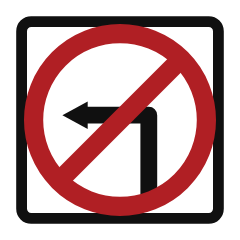
20. No plaque stating days or hours accompanies this sign at the intersection. When does the restriction apply?
Show answer
Answer D: At all times, since nothing limits it to particular periods
A regulatory restriction runs continuously unless a supplemental plaque states the days or hours during which it applies.
-
21. A Hawaii driver holds a telephone only to call the emergency number. What does the statute provide?
Show answer
Answer B: The conduct is an affirmative defense to the mobile device charge
Using a mobile electronic device for the sole purpose of making a 911 emergency communication is an affirmative defense to the charge.
-
22. Halfway through a curve you realize you are going too fast. What is the best response?
Show answer
Answer C: Ease off the gas gently and look where you want to go
Easing off transfers a little weight to the front tires without upsetting the balance, and looking through the curve keeps your steering smooth.
-
23. You brake hard in a vehicle with antilock brakes and feel the pedal pulsing under your foot. What should you do?
Show answer
Answer A: Keep firm, steady pressure on the pedal and steer where you need to go
The pulsing is the system releasing and reapplying the brakes so the wheels keep rolling, which is what lets you steer while braking. Pumping the pedal defeats it.
-
24. How is a breach of Hawaii's mobile electronic device law classified?
Show answer
Answer C: As a traffic infraction
Hawaii treats a violation of the mobile electronic device law as a traffic infraction as defined in the traffic infractions chapter.
-
25. Your engine stalls while you are driving in traffic. What is the correct response?
Show answer
Answer A: Shift to neutral, try to restart it, and steer and brake toward the side of the road
With the engine off, power steering and power brake assistance fade, so steering and braking take more effort but still work. Neutral lets you attempt a restart while you coast to safety.
-
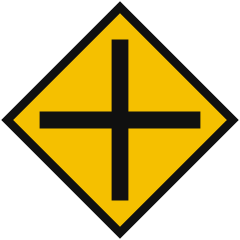
26. Does this sign settle who has the right-of-way at the intersection ahead?
Show answer
Answer D: No, it only gives notice of the intersection; the control there decides priority
A warning prepares the driver for what is coming but grants no priority, so whatever stop control, yield control, signal or right-of-way rule applies at the intersection is what decides.
-
27. In a work zone one lane sits an inch or two lower than the lane beside it. How should you change lanes?
Show answer
Answer C: Slow down and cross the edge at a shallow angle, holding the wheel firmly
A vertical edge between lanes can catch a tire and jerk the steering. Crossing slowly at a shallow angle lets the wheel climb without grabbing.
-
28. A pedestrian using a white cane or walking with a guide dog starts to cross the street ahead of you. What must you do?
Show answer
Answer A: Yield and stay stopped until the person has finished crossing
A white cane or guide dog identifies a pedestrian who may not be able to see your vehicle, so you must yield and wait rather than maneuver around the person. The horn can confuse the pedestrian or the dog.
-
29. How much moving water is generally enough to float and carry away most passenger vehicles?
Show answer
Answer D: About one foot
About a foot of moving water will float most cars, and even less will stall an engine. That is why the rule is to turn around instead of judging the depth.
-
30. A wasp flies in through the open window while you are driving. What is the safest reaction?
Show answer
Answer B: Stay calm, slow down and stop somewhere safe
Far more crashes come from the driver's reaction to an insect than from the insect, so keep your eyes forward, slow down and deal with it stopped.