
Hawaii HDOT MVSO Permit Practice Test 7
Test 7 of 10. Pick an answer for each question to see if it is right and why; your score appears at the end. You need 24 correct answers to pass, the same ratio as the real Hawaii test.
- Questions30
- Correct to pass24
- Passing score80%
- Minimum age15 years 6 months
-
1. What extra charge does Hawaii add when a driver exceeds the maximum speed limit by more than ten miles per hour?
Show answer
Answer D: A $10 surcharge deposited into the neurotrauma special fund
Hawaii imposes a $10 surcharge for the neurotrauma special fund, in addition to other penalties, when the maximum limit is exceeded by more than ten miles per hour.
-
2. The traffic around you is moving well above the limit on a wide highway. What should you do?
Show answer
Answer D: Keep to the limit and stay to the right, letting faster traffic pass
The limit is a legal maximum, and the safe way to differ from the traffic around you is to keep right and let it go by.
-
3. At night you are waiting to turn left and can see only the headlights of an approaching vehicle. Why should you allow a bigger margin?
Show answer
Answer D: Because lights alone make speed and distance hard to judge
With no other visual cues, two points of light give you very little information about how fast the vehicle is closing, so leave extra margin.
-
4. What does a first conviction for driving in Hawaii without being licensed carry?
Show answer
Answer C: A fine of up to one thousand dollars or up to thirty days in jail, or both
For a first unlicensed driving offense, or one not preceded within five years by the same offense, Hawaii sets a fine of no more than one thousand dollars or a jail term of no more than thirty days, or both.
-
5. Which equipment is excluded from Hawaii's definition of a mobile electronic device?
Show answer
Answer B: Gear built into the vehicle for navigation or rear seat video entertainment
The definition excludes audio equipment and equipment installed in the vehicle for navigation, for emergency assistance to the operator, or for rear seat video entertainment.
-
6. A police officer in the intersection raises a hand toward you although your signal is green. What should you do?
Show answer
Answer B: Stop and wait for the officer to wave you on
An officer directing traffic overrides signals and signs, and drivers must follow the officer even when the light says otherwise.
-
7. How fast may a neighborhood electric vehicle be driven in Hawaii?
Show answer
Answer B: No faster than twenty-five miles per hour
A neighborhood electric vehicle may not be operated at a speed of more than twenty-five miles per hour.
-
8. You are in a passing zone that continues over the crest of a hill ahead. May you start a pass?
Show answer
Answer B: Only if you can finish it well before the crest
Beyond the crest you cannot see oncoming traffic, so any part of the pass that happens there is being made blind.
-
9. Why are sign shapes and colors standardized across the whole country?
Show answer
Answer D: So a driver knows the kind of message before reading it
Uniform shapes and colors let a driver classify a sign as regulatory, warning or guide from a distance, before the legend can be read.
-
10. What speed limit does Hawaii law set for the Daniel K. Inouye Highway from mile marker twelve?
Show answer
Answer C: Sixty miles per hour
Hawaii Revised Statutes set the speed limit for the Daniel K. Inouye Highway at sixty miles per hour beginning at mile marker twelve.
-
11. A fire engine has stopped in answer to a fire alarm in Hawaii. What does the law say about parking nearby?
Show answer
Answer C: No vehicle may be parked within five hundred feet of where it stopped
Hawaii forbids driving or parking within five hundred feet of the place where an emergency vehicle has stopped in answer to a fire alarm.
-
12. A sign reads MINIMUM SPEED 40. What does it require of a driver?
Show answer
Answer C: Not to drive below that speed when conditions allow
A minimum speed limit keeps unnecessarily slow vehicles from obstructing traffic, but it never overrides the duty to slow down for weather or congestion.
-
13. How long can cannabis affect a driver?
Show answer
Answer A: For hours after the strongest effects have passed
Slowed reactions, poor tracking and weak judgment of distance can last for hours, well beyond the point where the user believes the effects are over.
-
14. You want to reverse direction but the street is too narrow for a U-turn. What is the alternative?
Show answer
Answer D: Make a three-point turn, or go around the block in heavy traffic
Where there is not enough width for a U-turn, the three-point turn does the job in stages, and on a busy street going around the block is safer still.
-
15. How does the County of Maui price a driver's license?
Show answer
Answer C: Ten dollars for each year of the term issued
The Maui fee schedule charges ten dollars for each year of the term, so an eight-year license costs eighty dollars and a two-year license for a driver of eighty or over costs twenty.
-
16. How many errors are allowed on the Kauai County non-commercial written examination?
Show answer
Answer A: No more than six errors
Kauai County publishes a thirty-question multiple choice non-commercial written test on which more than six errors is a failure.
-
17. The engine dies at speed and the dashboard lights go out on a dark road. What should you do?
Show answer
Answer C: Hold the wheel firmly, steer over to the shoulder and use the hazard lights
Never switch the ignition to lock, because the steering can lock; steer to the shoulder and warn traffic with the hazard lights.
-
18. What is the best way to keep your phone from distracting you on a trip?
Show answer
Answer D: Silence it and stow it before you start
A phone you cannot hear and cannot reach cannot tempt you, which is far more reliable than deciding case by case while you drive.
-
19. How are maximum and minimum speed limits established in Hawaii?
Show answer
Answer A: By county ordinance or by official signs placed by the director of transportation
Hawaii law defines a speeding violation by reference to limits set by county ordinance or by official signs placed by the director of transportation on highways under that jurisdiction.
-
20. When may a driver of a motor vehicle use a marked bicycle lane?
Show answer
Answer C: Only to cross it when turning or entering the road where the markings allow
A bike lane is a lane for cyclists. Motor vehicles may only cross it to enter or leave the road or to make a turn where the markings permit.
-
21. A yellow diamond showing two vertical arrows, one pointing up and one pointing down, warns that
Show answer
Answer A: the road ahead carries traffic in both directions
The two-way traffic sign warns that the roadway ahead is not divided and that vehicles will be coming from the opposite direction.
-
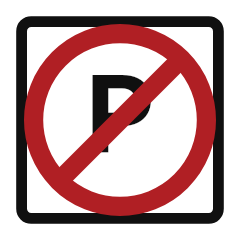
22. A driver leaves the vehicle at the curb where this sign is posted and walks away for two minutes. Is that allowed?
Show answer
Answer B: No, leaving the vehicle unattended there is prohibited whatever the length of the absence
Walking away leaves the vehicle parked, and the prohibition holds regardless of how long the driver is gone or whether the engine is left running.
-
23. What is the penalty for a first breach of the conditions on a Hawaii provisional license?
Show answer
Answer D: Suspension of the provisional license for three months by a court
A district court or family court judge suspends the provisional license for three months on a first violation, and the holder is not eligible for reissuance until turning eighteen or until three months have passed, whichever comes sooner.
-
24. In a vehicle with automatic transmission, which foot should operate the brake and accelerator?
Show answer
Answer D: The right foot for both pedals
Using only the right foot prevents pressing both pedals at once and keeps the response the same in every vehicle you drive. The left foot rests on the floor or the footrest.
-
25. Another driver takes a right of way that was legally yours. What should you do?
Show answer
Answer A: Give way to the other driver and avoid the crash, whatever the law says
Right of way is something you give, not something you take, and being in the right is no protection in a collision.
-
26. You are driving through a neighborhood where several children are riding bicycles. What should you do?
Show answer
Answer C: Slow down and expect sudden, unpredictable moves
Young riders lack the judgment and the mirror habits of adults and may swerve or cross without looking, so lower speed is your only reliable margin.
-
27. Apart from fitness to drive and payment of the fee, what can stop the examiner of drivers from renewing a Hawaii license?
Show answer
Answer B: The applicant owes charges and fines over the disposition of an abandoned vehicle
Hawaii law bars renewal while the applicant has outstanding charges and fines relating to the disposition of an abandoned vehicle.
-
28. A traffic signal ahead is showing a flashing red light. What does it require?
Show answer
Answer C: Stop completely, then go when the way is clear, as at a stop sign
A flashing red light has the same meaning as a stop sign: stop completely, yield to traffic and pedestrians, then proceed when it is safe.
-
29. What do the grooves in a tire tread do on a flooded road surface?
Show answer
Answer B: They give the water a way to escape so the tread can touch the road
Tread grooves pump water out from under the tire so rubber can meet pavement. A worn tread moves less water, so hydroplaning starts sooner.
-
30. You are in a minor collision on a busy road. No one is hurt and both vehicles can be driven. What is the recommended thing to do?
Show answer
Answer C: Move the vehicles out of the travel lanes to a safe spot before exchanging information
Vehicles left in traffic after a minor crash invite a second, often worse, collision. Clearing the lane protects everyone, and you still exchange details and report as required.