
Hawaii HDOT MVSO Permit Practice Test 3
Test 3 of 10. Pick an answer for each question to see if it is right and why; your score appears at the end. You need 24 correct answers to pass, the same ratio as the real Hawaii test.

- Questions30
- Correct to pass24
- Passing score80%
- Minimum age15 years 6 months
-
1. The road is icy and visibility is poor, but you are driving at the posted speed limit. Is this acceptable?
Show answer
Answer A: No, because you may never drive faster than is safe for the conditions
Under the basic speed rule a driver must travel at a speed that is reasonable for the actual conditions, so a legal posted speed can still be an unlawful and unsafe speed.
-
2. Why is a sign reading BRIDGE ICES BEFORE ROAD worth heeding even when the road itself is merely wet?
Show answer
Answer C: Cold air passes under a bridge as well as over it
A bridge deck loses heat from below as well as above, so it can be frozen while the road on either side of it is only wet.
-
3. On a school speed limit sign, the part carrying the word SCHOOL is shown
Show answer
Answer A: in black on a fluorescent yellow-green background
The SCHOOL portion of the school speed limit sign uses the same fluorescent yellow-green background as school warning signs, while the speed portion keeps the standard regulatory appearance.
-
4. A Hawaii provisional licensee drives home from work at midnight without a parent. What must be carried to make that lawful?
Show answer
Answer C: A statement signed by the employer giving contact details and the work hours
The employment exception applies only while the licensee carries a signed statement from the employer with the employer's name, address and telephone number and verification of employment and work hours.
-
5. A large truck is passing you on a two-lane road. What is the safest thing to do?
Show answer
Answer C: Keep right in your lane and ease off the gas a little
Staying in your own lane and easing off shortens the pass without forcing you onto a soft shoulder or into the truck's path.
-
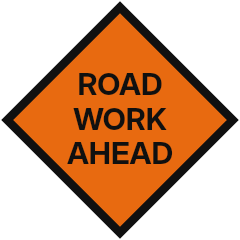
6. Beyond this sign, cones and temporary signs lead traffic along a path that does not agree with the lines painted on the pavement. Which one must the driver follow?
Show answer
Answer C: The temporary arrangement, because it replaces the permanent layout while the work lasts
Temporary traffic control set up for the work takes precedence over the permanent signs and markings, which no longer describe how the road is being used.
-
7. You are about to pass a bicyclist on a narrow two-lane road. What is the correct way to do it?
Show answer
Answer A: Wait for a clear gap and move well left, giving the rider wide space
Pass a cyclist as you would a car: wait for clear road, change lane position to leave generous clearance, and return only when the rider is well behind you.
-
8. A yellow diamond reading DIP warns a driver about
Show answer
Answer A: a short, sharp depression in the road surface
A dip is an abrupt low point that can jolt a vehicle or scrape its underside, so speed should be reduced before reaching it.
-
9. Two left-turn lanes are marked at the intersection and you are in the left one. What must you do?
Show answer
Answer A: Stay in your own lane all the way around the turn
With dual turn lanes each driver must hold a lane through the whole turn and come out in the matching lane of the new street.
-
10. A person is convicted of unlicensed driving in Hawaii for the third time within five years. What is the consequence?
Show answer
Answer B: The offense becomes a class C felony and the vehicle may be forfeited
A third or later unlicensed driving offense within five years is a class C felony, and the court may order the vehicle used in the offense to be forfeited.
-
11. How may a Hawaii motorist satisfy an officer's demand to see the motor vehicle insurance identification card?
Show answer
Answer A: By producing the card in paper form or on a mobile electronic device
The identification card must be in the insured vehicle or accessible on a mobile electronic device at all times, and must be exhibited to a law enforcement officer on demand.
-
12. You are on a one-way street with two marked lanes. May you pass a slower vehicle on the right?
Show answer
Answer A: Yes, using the right lane, provided that the move is safe and signaled
On a roadway with two or more marked lanes in your direction, moving into the free lane and going by is a normal lane change rather than an unlawful pass.
-
13. A Hawaii driver ignores a traffic citation and fails to appear at the place and time it names. What may the court add?
Show answer
Answer D: A charge of up to fifty dollars for issuing a penal summons
Hawaii lets the court assess a sum not exceeding fifty dollars for the cost of issuing a penal summons when a person fails to appear as the citation directs.
-
14. A piece of farm machinery ahead of you is wider than its own lane. What should you do?
Show answer
Answer C: Hold back until you can see far enough to pass safely
Wide equipment leaves no gap inside the lane and may use part of the other side, so a pass needs a long clear view of the road ahead.
-
15. A notification appears on your smart watch while you are driving. What should you do?
Show answer
Answer B: Treat it as you would a phone and leave it
A watch screen demands the same eyes and the same attention as a phone, and a wrist is no safer a place to read a message than a dashboard.
-
16. What is the relationship between Hawaii's mobile device statute and county ordinances on the same subject?
Show answer
Answer C: The state statute supersedes any county ordinance on the subject
Hawaii's mobile electronic device statute expressly supersedes any county ordinance regulating the use of such devices while operating a motor vehicle.
-
17. Your brake pedal sinks to the floor and the vehicle does not slow down. What is a reasonable sequence of actions?
Show answer
Answer C: Pump the pedal, shift to a lower gear and apply the parking brake gradually while steering to a safe spot
Pumping can rebuild pressure in a partly failed system, a lower gear adds engine braking, and easing on the parking brake slows the vehicle without locking the wheels.
-
18. What does Hawaii law mean by a highly intoxicated driver?
Show answer
Answer D: A driver whose measurable alcohol level is point one five or more
Hawaii defines a highly intoxicated driver as one with .15 or more grams of alcohol per hundred millilitres of blood, or the equivalent measured in breath.
-
19. You are waiting to pull out of a driveway when a bicyclist comes along the bike lane in front of you. What must you do?
Show answer
Answer D: Wait until the bicyclist has gone past
A driver leaving a driveway yields to everything already on the road, and a bike lane is part of the roadway.
-
20. Which vehicle is NOT within Hawaii's definition of an emergency vehicle for the stopped vehicle rule?
Show answer
Answer D: A refuse collection truck operated by a county public works department
The statutory list runs from police and fire vehicles through ocean safety, freeway service patrol, harbors division and conservation enforcement vehicles to tow trucks, but does not include refuse collection trucks.
-
21. On a narrow residential street, why does parking tight against the curb matter so much?
Show answer
Answer C: Because fire trucks and ambulances need the width to get through
Cars parked even a foot out from the curb on both sides can narrow a street until a fire truck or ambulance cannot pass.
-
22. A raised area crosses the roadway and carries a series of white markings on its face. What are those markings for?
Show answer
Answer A: To make the hump visible so drivers slow for it
Speed hump markings warn drivers that the pavement rises, which matters most at night or when the hump is in shadow.
-
23. Alcohol is classified as which kind of drug?
Show answer
Answer B: A depressant that slows the central nervous system
As a depressant, alcohol slows the brain and nervous system, which lengthens reaction time and dulls the coordination that driving depends on.
-
24. How long may a visitor drive in Hawaii on a compact foreign driver's license accompanied by an international driving permit?
Show answer
Answer C: One year after the date of entry into the United States
The manual treats a compact foreign license with an international driving permit as valid for one year from the date of first entry into the United States.
-
25. What treatment requirement does Hawaii impose for a first conviction of operating a vehicle under the influence of an intoxicant?
Show answer
Answer C: A substance abuse rehabilitation programme of at least fourteen hours
A first offense carries a fourteen-hour minimum substance abuse rehabilitation programme including education and counselling, or a comparable programme the court considers appropriate.
-
26. When should you adjust your seat, mirrors and steering wheel?
Show answer
Answer B: Before you start moving
Adjusting the driving position while moving takes your attention and often your hands away from driving. Make every adjustment while parked, every time.
-
27. What must you be sure of before you pull out to pass on a two-lane road?
Show answer
Answer A: That the road ahead is clear far enough for the whole pass
You need enough clear road to pull out, pass and return before any oncoming vehicle arrives, and you must judge that distance before you start.
-
28. What happens to other valid driver's licenses and identification cards when a person is issued a Hawaii driver's license?
Show answer
Answer C: They must be surrendered to the examiner of drivers, who shreds them
No person may hold more than one valid driver's license, so Hawaii requires every valid license and identification card in the applicant's possession to be handed over at the counter.
-
29. How long is the license revocation for a first conviction of operating under the influence in Hawaii?
Show answer
Answer D: No less than one year and no more than eighteen months
A first conviction carries revocation of the license for no less than one year and no more than eighteen months, with an ignition interlock device fitted to every vehicle the person operates.
-
30. Why is a wet road at night harder to read than the same road in daylight?
Show answer
Answer A: The wet surface reflects light away and swallows the lane markings
A film of water sends your headlight beam onward instead of back to you, so lines, edges and people in dark clothing almost disappear.