
Hawaii HDOT MVSO Motorcycle Practice Test 1
Test 1 of 6. Pick an answer for each question to see if it is right and why; your score appears at the end. You need 24 correct answers to pass, the same ratio as the real Hawaii test.
- Questions30
- Correct to pass24
- Passing score80%
- Minimum age15 years 6 months
-
1. How many alcoholic drinks does it take to begin affecting driving ability?
Show answer
Answer C: Even one drink can affect it
A single drink can slow reactions and weaken judgment before you feel any change. Impairment starts long before a person feels drunk.
-
2. A driver is following you far too closely. What is the best response?
Show answer
Answer D: Increase your own following distance and let the driver pass when it is safe
More room ahead of you means you can slow gradually instead of braking hard, which reduces the chance of being struck from behind, and letting the driver by removes the problem entirely.
-
3. Two solid white lines are painted between your lane and the lane beside it. What do they mean?
Show answer
Answer D: Crossing from one lane to the other is prohibited
Double solid white lines separate lanes of traffic going the same way and may not be crossed.
-
4. Your vehicle stalls on railroad tracks and you see a train approaching. What should you do?
Show answer
Answer D: Get everyone out and run toward the train at an angle away from the tracks
Leave the vehicle at once. Running toward the oncoming train and away from the tracks keeps you clear of the wreckage, which is thrown forward in the direction the train is moving.
-
5. A dog is running toward the road from a yard ahead of you. Why is it a mistake to simply accelerate past it?
Show answer
Answer A: A dog aims at where you will be, so more speed can bring you together
A dog runs at an intercept point rather than at where you are now, which is why the recommended technique is to slow as you approach and then accelerate away once you are beside it.
-
6. Hawaii's basic speed rule names particular places where a safe and appropriate speed is required. Which of these does it list?
Show answer
Answer B: When approaching a hill crest or traveling on a narrow or winding roadway
The basic rule requires a safe and appropriate speed at intersections and railroad crossings, on curves and hill crests, on narrow or winding roads, and where special hazards exist.
-
7. What fine does Hawaii set for exceeding the posted limit inside a school zone or a construction area?
Show answer
Answer A: Two hundred fifty dollars
Hawaii fixes a fine of two hundred fifty dollars for speeding in a school zone or a construction area, plus surcharges, and a school zone case adds a safe routes to school surcharge.
-
8. What most often leads to an engine seizure on a motorcycle?
Show answer
Answer A: Loss of engine oil or coolant, so the moving parts overheat and grip
Seizure is normally a lubrication or cooling failure, which is why oil level and coolant are part of every pre-ride check and why a rising temperature reading deserves attention.
-
9. A first-time Hawaii impaired driving offender is found to have been a highly intoxicated driver. What is added?
Show answer
Answer B: Forty-eight consecutive hours of imprisonment and six more months of revocation
A highly intoxicated first offender receives an additional mandatory forty-eight consecutive hours of imprisonment and an additional six months of revocation, making the revocation at least eighteen months.
-
10. A Hawaii driver holds a telephone only to call the emergency number. What does the statute provide?
Show answer
Answer B: The conduct is an affirmative defense to the mobile device charge
Using a mobile electronic device for the sole purpose of making a 911 emergency communication is an affirmative defense to the charge.
-
11. A Hawaii court sentencing a first impaired driving offense chooses to impose a fine. What range may it use?
Show answer
Answer A: Not less than two hundred fifty and not more than one thousand dollars
For a first offense the court may impose seventy-two hours of community service, forty-eight hours to five days of imprisonment, or a fine of no less than two hundred fifty and no more than one thousand dollars.
-
12. How are maximum and minimum speed limits established in Hawaii?
Show answer
Answer A: By county ordinance or by official signs placed by the director of transportation
Hawaii law defines a speeding violation by reference to limits set by county ordinance or by official signs placed by the director of transportation on highways under that jurisdiction.
-
13. A yellow pennant, an isosceles triangle with its long axis horizontal, is reserved for which message?
Show answer
Answer D: No passing zone
The pennant shape is used only for the no passing zone sign, which marks the point where overtaking is no longer allowed.
-
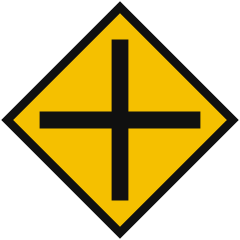
14. Does this sign settle who has the right-of-way at the intersection ahead?
Show answer
Answer D: No, it only gives notice of the intersection; the control there decides priority
A warning prepares the driver for what is coming but grants no priority, so whatever stop control, yield control, signal or right-of-way rule applies at the intersection is what decides.
-
15. A driver's blood alcohol concentration is below the legal limit, but the driver is visibly impaired. Can the driver be arrested?
Show answer
Answer C: Yes, driving while impaired by alcohol is an offense at any concentration
The per se figure, 0.08 percent in most states and 0.05 percent in Utah, is the level at which impairment is presumed. Impairment shown by driving behavior and field tests is enough on its own, because alcohol affects skills well before that number.
-
16. An adult convicted of impaired driving in Hawaii was carrying a passenger younger than fifteen. What is added to the sentence?
Show answer
Answer B: A fine of five hundred dollars and forty-eight hours of imprisonment
A person aged eighteen or over who drove with a passenger under fifteen faces an extra mandatory five hundred dollar fine and forty-eight hours of imprisonment, and the revocation becomes at least two years.
-
17. You are approaching a highway-rail grade crossing marked only with a crossbuck sign. What does that sign require?
Show answer
Answer A: Yield to any approaching train and cross only when the tracks are clear
The crossbuck is a regulatory yield sign, and a train can never stop or steer around a vehicle, so the driver must always give way.
-
18. What happens to a Hawaii driver whose test shows a blood alcohol content of .08 or more, or who refuses the test?
Show answer
Answer A: The license is taken away and a 30-day temporary driving permit is issued, with the right to request a hearing
Under Hawaii's administrative license revocation process the license is taken and a 30-day temporary permit is issued, and the driver may request a hearing.
-
19. Your light is green but the traffic beyond the intersection is stopped and there is no room on the far side. What should you do?
Show answer
Answer A: Wait behind the line until you can clear the far side
Entering an intersection you cannot clear blocks the cross traffic when their signal turns green, so you wait behind the line.
-
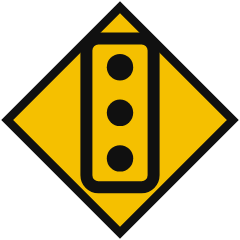
20. What does this sign require of the driver?
Show answer
Answer D: Reducing speed and being ready to stop at the intersection ahead
The advance notice asks the driver to slow and be ready to stop, while whether a stop is actually needed depends on the indication displayed on arrival.
-
21. You are stopped at a steady red arrow pointing right, and no sign or state rule permits turning on a red arrow. May you turn right?
Show answer
Answer A: No, you must wait until the red arrow goes out and a green signal appears
A steady red arrow prohibits the movement it points to until a signal permitting it appears. Only a posted sign or a specific state rule allows a turn on a red arrow after a complete stop, so without one you must wait.
-
22. You are about to pass a slower vehicle on a two lane road. What should you do with the gears?
Show answer
Answer B: Downshift before you begin, so the engine can accelerate strongly
A lower gear puts the engine in the part of its range where it accelerates best, which shortens the time spent in the oncoming lane.
-
23. You notice at night that one of your headlights has burned out. What should you do?
Show answer
Answer B: Get it replaced promptly, because other drivers may take you for a motorcycle
A single light makes your vehicle look narrower and further away, so other drivers misjudge you, and one light is also illegal.
-
24. What should a driver expect a short distance beyond this sign?
Show answer
Answer C: Another road crossing the one being traveled
Traffic may enter or cross from either side at the intersection ahead, so the driver should ease off, cover the brake and check both approaches.
-
25. A bicyclist stops at a four-way stop just before you do. Who goes first?
Show answer
Answer B: The bicyclist, who reached the intersection and stopped there before you did
A bicyclist on the roadway follows the same right of way rules as a driver, so arrival order decides the turn.
-
26. May you stop in the striped triangle that separates an exit ramp from the freeway lanes?
Show answer
Answer A: No, it is not a lane and stopping there is dangerous
The striped gore area is not a travel lane or a shoulder, and a vehicle stopped there sits directly in the path of drivers correcting a late exit.
-
27. A steady red arrow is displayed for your left-turn lane at a two-way intersection. What must you do?
Show answer
Answer C: Stop and remain stopped until an indication permits the turn
A steady red arrow prohibits the movement it points to, so the driver stops and waits for a green arrow, a flashing yellow arrow or another indication that permits the turn.
-
28. How long may a Hawaii license be revoked for refusing a requested alcohol test?
Show answer
Answer D: Two, four or eight years, depending on prior alcohol enforcement contacts
Hawaii revokes the license of a driver who refuses testing for two, four or eight years according to prior alcohol enforcement contacts, double the one, two or four year periods that apply to a driver who tests .08 or more, and the driver can still be charged with driving under the influence.
-
29. For the purposes of Hawaii's mobile device law, is a driver stopped at a red light still operating the vehicle?
Show answer
Answer B: Yes, since operation covers a vehicle temporarily stationary at a signal
Hawaii defines operating a motor vehicle to include operation while temporarily stationary because of traffic, a traffic light or a stop sign.
-
30. How long must a Hawaii applicant aged 16 to 18 practice on a motorcycle instruction permit before taking the skills test?
Show answer
Answer C: At least 180 days
Applicants aged 16 to 18 must hold the motorcycle instructional permit and practice for at least 180 days, in addition to earning the driver education and behind-the-wheel completion certificates.