
Hawaii HDOT MVSO Motorcycle Practice Test 4
Test 4 of 6. Pick an answer for each question to see if it is right and why; your score appears at the end. You need 24 correct answers to pass, the same ratio as the real Hawaii test.
- Questions30
- Correct to pass24
- Passing score80%
- Minimum age15 years 6 months
-
1. You need to leave the road and pull onto the shoulder. What should you check first?
Show answer
Answer A: Whether the shoulder surface is firm enough to support the motorcycle
Soft or loose shoulder material can grab the wheels or let the side stand sink, so confirm the surface is firm, signal, and then pull well clear of traffic.
-
2. Why is passing another vehicle a bad idea in dense fog?
Show answer
Answer C: You cannot see far enough ahead to know the passing lane is clear
A pass needs a clear view of the road well beyond the vehicle you are overtaking, and fog takes exactly that away.
-
3. A school sign paired with a plaque showing a diagonal downward-pointing arrow is installed
Show answer
Answer D: at the school crossing itself, or as close to it as possible
The diagonal downward arrow points at the crossing, so this assembly is placed at the crossing location rather than in advance of it.
-
4. Smoke and flames appear from the engine compartment after you stop. What should you do?
Show answer
Answer A: Get everyone well away from the vehicle first, and then call the fire service
A vehicle fire can spread within seconds, so people come out first and firefighting is left to the fire service.
-
5. A stop line is painted across the pavement at this sign. Where must the vehicle come to rest?

Show answer
Answer A: Behind the stop line, with no part of the vehicle across it
The vehicle must halt behind the stop line; where no line is painted the driver stops before the crosswalk, and where there is neither, before entering the intersection.
-
6. When does Hawaii law require safety glasses, goggles or a face shield on a motorcycle or motor scooter?
Show answer
Answer D: Whenever the motorcycle or motor scooter is not equipped with a windshield or windshield
Hawaii requires the operator and any passenger to wear safety glasses, goggles or a face shield when the machine has no windshield or windshield.
-
7. What situations trigger the duty owed to a stopped emergency vehicle in Hawaii?
Show answer
Answer B: An emergency, an investigation of a possible traffic violation, or other official duties
The duty arises where an emergency vehicle is stopped for an emergency, an investigation of a possible traffic violation, to render assistance to a police officer, or on other official duties, as shown by its flashing lights.
-
8. What speed limit does Hawaii law set for the Daniel K. Inouye Highway from mile marker twelve?
Show answer
Answer C: Sixty miles per hour
Hawaii Revised Statutes set the speed limit for the Daniel K. Inouye Highway at sixty miles per hour beginning at mile marker twelve.
-
9. A twenty-year-old in Hawaii is convicted of driving with a measurable amount of alcohol for the first time. What suspension does the court impose?
Show answer
Answer B: One hundred eighty days, though an adult may get a restricted license part way
A first violation brings a prompt one hundred eighty day suspension, although a person aged eighteen or over may instead receive thirty days of absolute prohibition and then a work-limited license for the rest of the period.
-
10. Which vehicles must display a slow moving vehicle emblem on a Hawaii public highway?
Show answer
Answer A: Any vehicle designed to operate at twenty-five miles per hour or less
Hawaii requires the triangular emblem on any vehicle or combination designed to operate at twenty-five miles per hour or less, mounted base down between three and five feet above the ground.
-
11. You have a green light and are turning right. Pedestrians are stepping off the curb into the crosswalk you are about to cross. What should you do?
Show answer
Answer B: Wait and let them cross before completing your turn
A green light does not release a turning driver from yielding to pedestrians already in the crosswalk of the street being entered.
-
12. How should a helmet sit on the head once it is fastened?
Show answer
Answer C: Level on the head, with the eye port giving a clear view of the road
A helmet worn level protects the forehead and gives full vision, while one pushed back leaves the forehead exposed in a crash.
-
13. What causes the side to side motion a rider feels when crossing a steel grid deck or rain grooves?
Show answer
Answer C: The tires following the ridges and grooves, which is normal and harmless
The tread follows the pattern in the surface, which produces a wandering feel. The motorcycle is not out of control, so relax on the bars and hold your speed.
-
14. How close may a Hawaii driver follow an emergency vehicle that is traveling in response to an emergency?
Show answer
Answer C: No closer than five hundred feet
A driver not on official business may not follow an emergency vehicle responding to an emergency closer than five hundred feet.
-
15. It is cold and the road looks wet, but you notice the tires of vehicles ahead are throwing up no spray. What does this suggest?
Show answer
Answer B: The surface has frozen and is probably icy
Water throws spray, but ice does not. A shiny road with no spray in freezing temperatures is a strong sign of black ice, so slow down and avoid sudden inputs.
-
16. When may a passenger get off the motorcycle?
Show answer
Answer D: Only after the rider has stopped, braced the machine and said so
A passenger climbing off before the rider is ready removes weight from the back of a machine the rider is still holding upright, which can drop it.
-
17. On a rural two-lane road you pass small blue signs, each naming one business with an arrow and a distance. What are they?
Show answer
Answer D: Tourist-oriented directional signs for traveler businesses
Tourist-oriented directional signs carry a white legend on blue and are used on rural conventional roads to guide travelers to eligible businesses.
-
18. What should be done with a group that has grown too large to manage?
Show answer
Answer D: Split it into smaller groups, each with its own leader and sweep rider
Smaller sub groups stay together more easily and are easier for other drivers to pass, and each one needs its own leader and sweep rider.
-
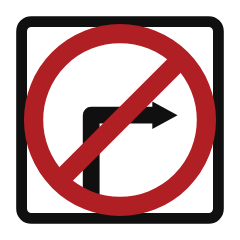
19. A driver stopped at a red signal wants to turn right and this sign is posted at the corner. What is permitted?
Show answer
Answer A: Nothing: the turn is barred whether the signal is red or green
The restriction works independently of the signal, so the usual permission to turn right after stopping at a red light does not exist where this sign is posted.
-
20. You are stopped in a shared through and right-turn lane with your right signal on, and a bicyclist rides up along your right side. What should you do?
Show answer
Answer A: Let the bicyclist clear the intersection or move ahead before you turn
A cyclist alongside your right side is in the path your turn will sweep across, so wait until that space is clear before turning.
-
21. What does a broken line indicate, whatever color it is painted?
Show answer
Answer C: That crossing it is permitted
A broken line always describes a permissive condition, and the color then tells the driver whether the traffic beyond it runs the same way or the opposite way.
-
22. What is the maximum speed at which a moped may be driven in Hawaii?
Show answer
Answer A: Thirty-five miles per hour
Hawaii law forbids driving a moped faster than thirty-five miles per hour, on top of the general requirement to drive at a reasonable and prudent speed.
-
23. Since 26 December 2025, what must be completed before applying for a Hawaii Class 2 motorcycle permit?
Show answer
Answer A: A state-approved basic safety rider course
Act 66 of 2025 requires completion of a state-approved basic safety rider course before an applicant may apply for a Class 2 permit to operate a motorcycle or motor scooter on Hawaii roadways.
-
24. A highway lane is marked with a large white diamond and signed as a high-occupancy vehicle lane. Who may use it?
Show answer
Answer B: Only vehicles carrying at least the number of occupants shown on the sign, during the posted hours
The diamond marking identifies a preferential lane whose occupancy requirement and hours of operation are stated on the accompanying signs.
-
25. School warning signs use which background and legend colors?
Show answer
Answer A: A black legend and border on a fluorescent yellow-green background
School warning signs carry a black legend and border on a fluorescent yellow-green background, a shade chosen so they stand out from ordinary yellow warning signs.
-
26. What is the most effective way for a rider to be seen by other drivers?
Show answer
Answer C: Wear brightly colored reflective gear, or a reflective vest over dark clothing
The most common thing drivers say after a collision with a motorcycle is that they never saw it, and bright reflective gear on the helmet and torso is the largest visible surface the rider controls.
-
27. Where may a three-wheeled moped be driven in Hawaii?
Show answer
Answer C: Only on roadways with a posted speed limit of thirty-five miles per hour or less
A three-wheeled moped is restricted to roadways with a posted speed limit of thirty-five miles per hour or less.
-
28. Why should you make sure your turn signal has stopped flashing after a lane change?
Show answer
Answer A: A signal left flashing tells other drivers that you intend to move again
Other drivers act on your signals, so one that is left on gives them false information about what you are about to do.
-
29. What extra restriction does Hawaii place on drivers under 18 regarding mobile electronic devices?
Show answer
Answer A: They may not use even a hands-free device, except to make a 911 emergency call
Hawaii bans holding a mobile electronic device for all drivers, and additionally bars drivers under 18 from using a hands-free device except for a 911 emergency communication.
-
30. Which restrictions apply to a Hawaii motorcycle instruction permit holder?
Show answer
Answer C: No passengers may be carried and the motorcycle may not be operated during the hours of darkness
A Hawaii motorcycle instruction permit bars carrying passengers and bars operating during the hours of darkness while learning to ride; the permit is valid for one year.