
Hawaii HDOT MVSO Motorcycle Practice Test 5
Test 5 of 6. Pick an answer for each question to see if it is right and why; your score appears at the end. You need 24 correct answers to pass, the same ratio as the real Hawaii test.
- Questions30
- Correct to pass24
- Passing score80%
- Minimum age15 years 6 months
-
1. During what hours must lighted head lamps be used on a Hawaii public highway?
Show answer
Answer B: From thirty minutes after sunset until thirty minutes before sunrise
Hawaii requires lighted head lamps from thirty minutes after sunset until thirty minutes before sunrise, and the lamps must reveal a person or object two hundred feet straight ahead.
-
2. A delivery truck is parked in your lane and you must use the oncoming lane to get around it. Who has the right of way?
Show answer
Answer D: The oncoming traffic, because their lane is clear
The driver whose own lane is obstructed waits, because using the other lane is a favor from oncoming traffic, not a right.
-
3. What does Hawaii law mean by a highly intoxicated driver?
Show answer
Answer D: A driver whose measurable alcohol level is point one five or more
Hawaii defines a highly intoxicated driver as one with .15 or more grams of alcohol per hundred millilitres of blood, or the equivalent measured in breath.
-
4. You are stopped at an intersection where bushes block your view of cross traffic. What should you do?
Show answer
Answer A: Edge forward slowly until you can see, then proceed when clear
Creeping forward a little at a time lets you gain a view without committing to the crossing. Never enter an intersection you cannot see into.
-
5. A Hawaii driver exceeds a school zone limit by thirty-five miles per hour. Which rule governs the case?
Show answer
Answer A: The excessive speeding statute rather than the school zone provision
Where the driver exceeds the school zone or construction area limit by thirty miles per hour or more, or drives at eighty miles per hour or more, the excessive speeding statute takes over.
-
6. What is the fine range for a first excessive speeding offense in Hawaii?
Show answer
Answer D: Not less than $500 and not more than $1,000
Hawaii sets a fine of $500 to $1,000 for a first excessive speeding offense, along with a 30-day prompt license suspension, driver retraining and community service or jail.
-
7. The vehicle you have borrowed is larger and heavier than your own. How should you drive it?
Show answer
Answer B: Allow more room for stopping and for turns until you are used to it
Extra weight and length mean longer stopping distances and wider turns, so give yourself more room until you are used to it.
-
8. A Hawaii driver is convicted of impaired driving within ten years of an earlier conviction. What revocation period applies?
Show answer
Answer B: No less than two years and no more than three years
A second offense within ten years of a prior conviction carries revocation of no less than two years and no more than three years, with an ignition interlock device during the revocation period.
-
9. Which of these is included in Hawaii's definition of an emergency vehicle for the stopped vehicle rule?
Show answer
Answer A: A tow truck
Hawaii's definition covers police and fire vehicles, ocean safety vehicles, emergency medical services vehicles, freeway service patrol vehicles, sheriff and emergency management vehicles, harbours and conservation enforcement vehicles, and tow trucks.
-
10. How much space should you hold behind the rider who is directly ahead of you in your own portion of the lane?
Show answer
Answer D: At least two seconds
Riders sharing the same track keep a following distance of at least two seconds so they have the time and the room to react to a hazard.
-
11. How does alcohol typically affect a driver's vision?
Show answer
Answer D: It blurs vision, weakens night vision and narrows attention to the sides
Alcohol slows the eye muscles and the brain's processing of what is seen, degrading focus, night vision, depth perception and awareness of movement at the edges of the field of view.
-
12. A large group has been divided into smaller groups. What should be done between them?
Show answer
Answer A: Leave a gap big enough for other vehicles to move in and pass safely
A gap between sub groups lets other traffic pass or merge without cutting into a formation, which keeps drivers from making sudden moves around the riders.
-
13. A Hawaii driver breaches the stopped emergency vehicle rule and someone is injured as a result. What follows?
Show answer
Answer D: The driver is charged instead under the negligent injury or homicide sections
Where a death or injury is attributable to the driver, the case is charged under the negligent homicide or negligent injury sections of the penal code rather than as a traffic violation.
-
14. What should a rider understand about the horn on a motorcycle?
Show answer
Answer A: It is often weak and may not be heard, so it never replaces an escape route
A small horn competes with a closed car, a radio and traffic noise, so a rider plans a way out instead of trusting the horn to be heard.
-
15. A yellow diamond shows a car with wavy lines behind its rear tires. What is the warning?
Show answer
Answer D: The surface loses grip badly when it is wet
The slippery when wet sign marks a stretch where traction falls off sharply in rain, so speed and braking must be reduced well in advance.
-
16. How can you tell a tire has reached its wear limit without measuring it?
Show answer
Answer C: The wear bars across the grooves become level with the tread
Molded bars sit at the bottom of the grooves. Once the surrounding tread has worn down to them, the tire has reached the end of its safe life.
-
17. A signal beside a fire station stays dark until apparatus is about to leave, when it shows yellow and then red. What must a driver do?
Show answer
Answer B: Stop on the red and wait until the signal goes dark again
An emergency vehicle signal is a real traffic signal, so its red indication must be obeyed while the apparatus pulls out into the street.
-
18. You are riding a shaded back road in autumn and reach a mat of wet leaves covering the pavement. What should you expect?
Show answer
Answer D: Traction can be nearly as poor as ice, so slow down before you reach them
Wet leaves are slick and they hide whatever is underneath, so reduce speed before the patch and cross it upright without braking or turning.
-
19. You reach an intersection with no signs, signals or markings clearly before a vehicle that is approaching on your right. What is the rule?
Show answer
Answer B: You may go first because you got there first
At an uncontrolled intersection the first driver to arrive goes first; the yield to the right rule only settles a tie.
-
20. Which clothing color is most likely to get a rider noticed in daylight?
Show answer
Answer B: Bright orange, yellow or green, which contrast with backgrounds
High visibility colors stand out against road, foliage and vehicles, which helps drivers pick a motorcycle out of a busy background during the day.
-
21. Which item does most to keep a rider comfortable in cold weather beyond a jacket and gloves?
Show answer
Answer B: A close fitting neck cover that stops air entering at the collar
Cold air funnelled in at the neck chills the whole body, so a snug neck tube or balaclava makes a large difference, while a loose scarf is a hazard because it can catch.
-
22. You have turned onto a ramp at night and your headlights pick out large white arrows painted on the pavement pointing straight back at you. What do they mean?
Show answer
Answer C: You are traveling against the flow and must turn back
Wrong-way arrows are laid so that a driver going the correct way never sees them head on, so an arrow pointing at you means you are on the ramp backwards.
-
23. How may a Hawaii motorist satisfy an officer's demand to see the motor vehicle insurance identification card?
Show answer
Answer A: By producing the card in paper form or on a mobile electronic device
The identification card must be in the insured vehicle or accessible on a mobile electronic device at all times, and must be exhibited to a law enforcement officer on demand.
-
24. Which driver is expressly exempt from Hawaii's ban on holding a device while driving?
Show answer
Answer B: A licensed amateur radio operator using a half-duplex two-way radio
The statute exempts drivers holding a valid amateur radio operator license from the Federal Communications Commission who are using a half-duplex two-way radio.
-
25. What fine does Hawaii impose on a driver convicted of having no motor vehicle insurance policy in force?
Show answer
Answer B: Five hundred dollars
Where the driver is convicted of having had no policy in force when the citation was issued, the fine is five hundred dollars for the first offense.
-
26. You are approaching the crest of a hill and cannot see the road beyond it. What should you do?
Show answer
Answer C: Slow down and keep well to the right
Beyond a blind crest there may be a stopped vehicle, a cyclist or an oncoming driver crossing the center line, so reduce speed and hold your own side.
-
27. Why is it useful to watch the vehicle two or three places ahead of you?
Show answer
Answer C: You get an earlier warning of slowing traffic than brake lights give
Trouble travels back through a line of traffic, so seeing it start several vehicles ahead gives you a head start on braking.
-
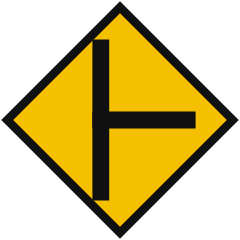
28. What condition does this sign warn a driver about?
Show answer
Answer B: Another road joins the road being traveled, from one side
It announces a side road entering the main roadway, so the driver should expect vehicles waiting to pull out and other vehicles slowing to turn in.
-
29. What insurance must a three-wheeled moped carry in Hawaii?
Show answer
Answer D: Liability and property damage cover, excluding personal injury protection
Hawaii requires three-wheeled mopeds to be insured for liability and property damage, but excludes personal injury protection from that requirement.
-
30. What must you do before changing lanes, in addition to signaling and checking your mirrors?
Show answer
Answer D: Glance over your shoulder to check the blind spot the mirrors do not cover
Mirrors leave an area beside and behind the vehicle that they cannot show, so a quick head check is needed before the vehicle moves sideways.